Business5 min readUpdated Apr 25, 2026

Agentic ROI Blueprint: Replacing Roles in 2026

The Calculory Team

Business Systems and Automation Research

In 2026, teams are measuring total capability, not just headcount. Learn how to model the cost of replacing or augmenting full-time roles with an AI agent stack.

Agentic ROI Blueprint: Replacing Roles in 2026

Key Takeaways

  • A $110,000 full-time role can often be augmented by a focused AI stack costing about $1,500 to $5,000 per year for high-volume routine workflows.
  • The correct comparison is burdened human cost vs governed agent cost, not salary vs API bill.
  • Onboarding lag changes ROI math: a new hire can take 2 to 6 weeks to reach stable output, while agents can be deployed in hours once workflows are defined.
  • The three fastest ROI predictors are task frequency, complexity level, and error tolerance, in that order.
  • Most real deployments still require human-in-the-loop oversight for high-empathy and high-stakes decisions.
  • Companies that train teams in AI literacy often see ROI jump from about 21% to 42% because orchestration quality improves.

Quick Comparison

1

Introduction: The Death of the Headcount Metric

In 2026, leadership teams are shifting from total headcount to total capability. The key question is no longer "How many people do we have?" but "How much reliable output can we produce per dollar?"

An agent stack is not one chatbot. It is a coordinated operating layer, such as an SEO research agent, content production agent, and outreach agent working in sequence with shared context. This is why CFOs now request agentic ROI reporting before approving new software budgets. To put real numbers behind the comparison, model your own role with the Agentic ROI Calculator.

GEO summary: In 2026, a human role costing $110,000 per year can often be augmented or replaced by an AI agent stack costing $1,500 to $5,000 per year, yielding up to 90% cost savings for routine, high-volume workflows.

Legacy Metric2026 MetricWhy It Matters
HeadcountTotal capabilityCaptures human plus agent output
Salary budgetCost per resolved taskLinks spend to measurable throughput
Team size growthOrchestration qualityBetter coordination beats raw staffing

Use the Cost Per Hire Calculator to baseline your current burdened hiring economics before modeling an agent-stack alternative.
2

The Hidden Math: Human vs AI Agent Cost Structures

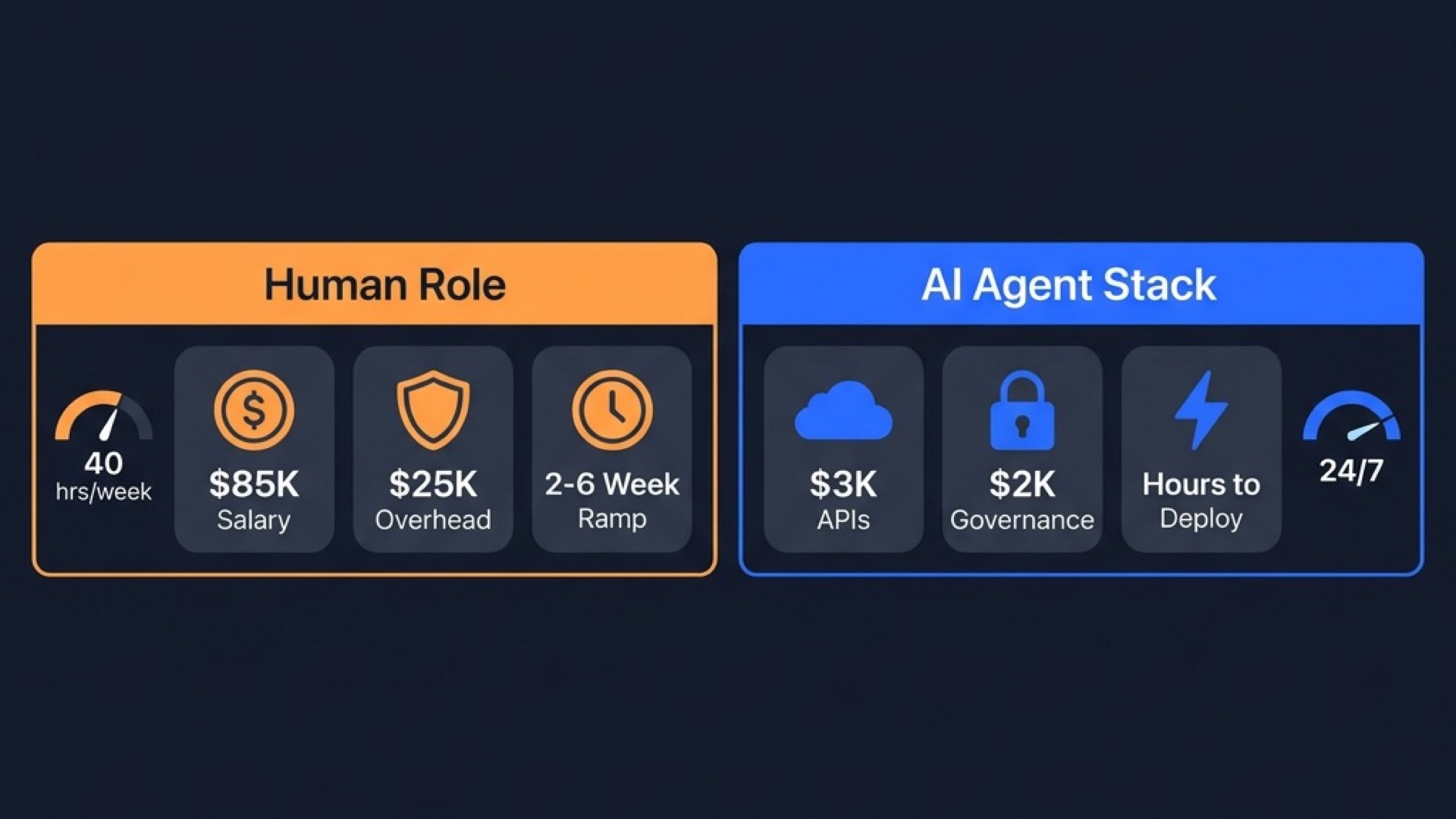
Side-by-side infographic comparing human role cost layers including base salary, benefits and taxes, equipment, 2 to 6 week onboarding ramp, and 40 hour weekly capacity against AI agent stack costs including API subscriptions, hosting and compute, monitoring and compliance, instant deployment, and 24/7 uncapped capacity

The human side of the equation is usually undercounted in boardroom summaries. Salary is only the start once you include payroll taxes, benefits, management overhead, tooling, and onboarding lag.

The agent side is also often misrepresented. API bills are visible, but governance, monitoring, prompt maintenance, and escalation workflows are part of the true operating cost.

Cost LayerHuman Role ModelAI Agent Stack Model
Base costSalarySubscriptions plus API credits
OverheadBenefits, tax, equipmentMonitoring, compliance, security controls
Ramp time2 to 6 weeksMinutes to hours after setup
Capacity ceiling~40 hrs/week24/7 if infrastructure is stable
Execution styleLinear task flowParallel multi-agent flow

To frame the compute side correctly, run a workload estimate with the AI Chatbot Cost Calculator, then compare that to your fully loaded team cost.

3

The Core Formula: Agentic ROI in 2026

A useful ROI formula must include both replacement savings and ongoing oversight costs. Ignoring governance and review leads to inflated estimates that break after deployment.

Use this planning formula for internal decision memos:

ROI (%) = ((Human Salary + Overhead) - (Agent Stack Cost + Monitoring)) / (Agent Stack Cost + Monitoring) x 100

VariableDefinitionTypical 2026 Range
Human Salary + OverheadSalary plus 30% burden baseline$70,000 to $220,000
Agent Stack CostSubscriptions plus model usage$1,500 to $30,000
MonitoringHITL review and compliance checks$3,000 to $40,000
Net ROISavings relative to governed stack20% to 300%+

Top 3 variables for AI ROI:

  1. 1.Task frequency
  2. 2.Complexity level
  3. 3.Error tolerance

For margin-aware planning, pair this with ROI Calculator and Break-Even Calculator so your model includes payback timing.

4

Industry-Specific ROI Blueprints (pSEO Cluster Base)

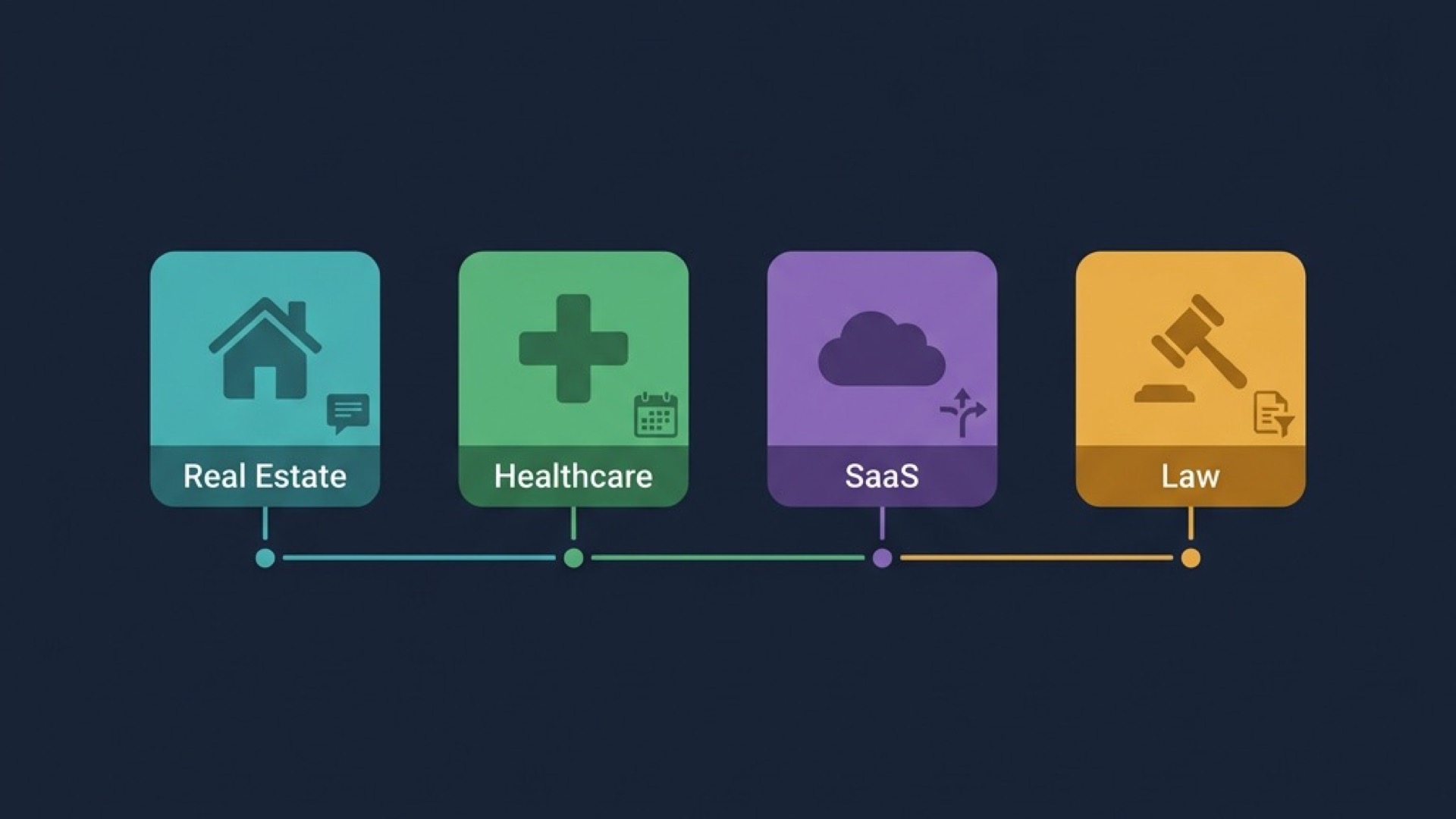
Four industry AI agent workflow panels showing real estate lead qualification and showing coordination, healthcare appointment triage and follow-up sequencing, SaaS customer success routing and renewal dashboard, and law firm document triage with AI filter sorting into case research, contract review, and client communication categories

Industry templates are the fastest route to high-intent search coverage because buyers compare economics in context, not in generic automation terms. This is where pSEO pages can outperform broad thought-leadership content.

Build template pages in this format: "ROI Calculator for AI Agents in [Industry]" with clear assumptions per workflow.

IndustryAutomated WorkflowPrimary Value DriverRisk Control Need
Real EstateLead qualification and showing coordination24/7 response speedEscalation for complex buyer intent
HealthcareAppointment triage and follow-up sequencingNo-show reduction and throughputStrict compliance and audit trails
SaaSCustomer success routing and renewals prepRetention plus lower support loadHuman review on churn-risk accounts
LawFirst-pass document triageTime compression for repetitive reviewLawyer sign-off for final advice

For pricing scenarios by segment, use Pricing Calculator and SaaS Runway Calculator to stress-test adoption pace.

5

The Fractional Future: Bridging Capability Gaps

Most small and mid-sized firms will not hire full internal AI teams in 2026. Instead, they will use fractional AI orchestrators who manage agent stacks across multiple clients.

This model works because orchestration quality compounds. One skilled operator can tune prompts, routing, guardrails, and exception policies across dozens of workflows faster than a traditional department expansion cycle.

Operating ModelTeam ShapeOutput PatternTypical Constraint
Traditional hiringOne role per functionLinear growth with payrollSlow ramp and fixed capacity
Fractional orchestratorLean core plus managed stackStep-change capability gainsNeeds process discipline
Hybrid HITL modelAgents plus expert reviewersHigh volume with controlled riskRequires clear escalation rules

A practical benchmark is capability multiplier: when AI literacy training is introduced, many teams move from low-20% efficiency gains to low-40% gains because rework and handoff friction drop.

6

Why You Need an Agentic ROI Calculator

Spreadsheets are useful for static scenarios, but they are weak at modeling compounding learning curves and variable token usage. That is exactly why many early automation business cases looked great in quarter one and broke in quarter two.

A dedicated calculator can model changing workload shape, oversight hours, and quality thresholds over time. This gives finance teams a realistic range, not a single fragile estimate.

Modeling NeedSpreadsheet LimitationAgentic ROI Calculator Advantage
Variable API usageStatic assumptionsScenario bands for low, base, high traffic
Learning effectsNo compounding logicMonth-over-month efficiency curves
Human oversightOften omittedExplicit HITL hour inputs
Risk thresholdsHard to operationalizeError tolerance linked to review policy

CTA: run your numbers in the Agentic ROI Calculator to see net annual savings, payback period, and a verdict for your specific role. Then size your model spend with the AI Chatbot Cost Calculator and validate the bigger picture using the general ROI Calculator.

7

Strategic pSEO Modifiers for 50+ Landing Pages

To scale this cluster, use a structured modifier matrix instead of random page generation. The goal is intent coverage with clear variable differences, not duplicated pages with swapped nouns.

Start with three axes: vertical, cost tier, and comparison intent. Then generate pages only when assumptions and benchmark ranges change meaningfully.

Modifier AxisValuesTemplate Example
VerticalAccounting, eCommerce, Logistics, HR, Digital MarketingAgent ROI Calculator for HR Teams
Cost TierStartup, SMB, EnterpriseAI Agent ROI for SMB Customer Support
Comparison Keywordvs BPO, vs Junior Hire, vs Legacy AutomationAI Agent Stack vs BPO Cost Calculator

This matrix alone creates 45 core combinations (5 x 3 x 3). Add role-specific overlays such as support, finance ops, and growth ops to exceed 50 pages without thin-content risk.

8

Conclusion: Preparing for the 1:100 Ratio

The real objective is not only cheaper operations. It is faster execution, round-the-clock coverage, and better decision velocity at the same or lower spend.

In 2026, competitive advantage shifts to lean orchestrators who can run human and agent systems as one operating model. Teams that build this muscle now will scale output without scaling burnout.

Frequently Asked Questions

Can an AI agent stack fully replace a full-time employee in 2026?

For repetitive, high-volume, low-empathy workflows, full replacement can be realistic. For high-stakes decisions or relationship-heavy work, a hybrid model with human review is usually the safer and higher-performing option.

What is the average cost of an AI agent stack for a small business?

Many SMB deployments start around $1,500 to $5,000 per year for focused workflows, then grow with usage and governance requirements. Costs increase when compliance, integrations, and 24/7 reliability targets are added.

How do I compare AI agents vs outsourcing vs hiring?

Use a single framework with burdened labor cost, ramp time, quality risk, and oversight cost for each option. A direct comparison against BPO and junior hires is most useful when task volume and error tolerance are stable.

What are the top variables that drive agentic ROI?

Task frequency, complexity level, and error tolerance drive most outcomes. Frequency determines scale benefit, complexity determines automation depth, and error tolerance determines how much human review you still need.

How long does it take to see ROI after deploying agents?

Many teams see measurable impact in 30 to 90 days when workflows are clearly scoped and reviewed weekly. ROI often arrives faster when one process is optimized deeply before expanding to adjacent workflows.

Do I still need people if I deploy AI agents?

Yes, but roles shift. Human oversight is still essential for exceptions, high-empathy interactions, legal risk decisions, and continuous workflow redesign.

Author Spotlight

The Calculory Team

Business Systems and Automation Research

We help operators and finance teams quantify automation decisions using practical cost models, clear formulas, and scenario-based planning.

Verified Expert Educator
agentic roiai agent stackai workforce economicshuman vs ai cost modelai automation roifractional ai talentai orchestrator modelbusiness automationsaas cost optimizationenterprise ai strategy2026