Maths9 min readUpdated Apr 25, 2026

Best Math Training Apps in 2026: 12 Picks for Students, Adults, and Speed Enthusiasts

The Calculory Team

Content and Research

We tested 12 math training apps across four categories: academic support, logical reasoning, mental math speed, and gamified learning. See which apps actually improve your skills in 2026.

Best Math Training Apps in 2026: 12 Picks for Students, Adults, and Speed Enthusiasts

Key Takeaways

  • Khan Academy remains the best free math app for structured K-12 and college learning, with mastery-based paths and official SAT and AP prep.
  • Brilliant.org leads for adults seeking deep STEM intuition through interactive puzzles rather than passive video watching.
  • Photomath and Google Lens are the fastest homework helpers, scanning handwritten equations with your camera for instant step-by-step solutions.
  • For pure mental math speed, FastMath (iOS) and Math Workout (Android) offer daily drills with leaderboards and customizable difficulty.
  • Gamified apps like Prodigy Math and DragonBox secretly teach algebra and geometry through RPG gameplay, ideal for kids aged 6 to 14.
  • The 15-minute daily practice rule beats weekly cramming sessions for long-term math fluency, according to cognitive science research.

Quick Comparison

Why Use a Math Training App in 2026?

The way we learn math has shifted dramatically. Rote memorization is giving way to intuitive problem-solving powered by adaptive AI. Modern math apps like Photomath and Khan Academy's Khanmigo now use artificial intelligence to explain the "why" behind every step, not just the "how." Whether you are a student preparing for exams, an adult sharpening logical reasoning, or a professional upskilling for a data-driven career, there is a math training app designed for your specific goal.

Before choosing an app, identify your path:

GoalBest App CategoryTime Commitment
Academic support (K-12, college)Structured learning platforms20 to 30 min/day
Mental fitness and speedSpeed drill apps10 to 15 min/day
Career upskilling (STEM, data)Logic and reasoning platforms15 to 20 min/day
Kids engagement (ages 6 to 14)Gamified math apps15 to 20 min/day

This guide covers the 12 best math training apps across all four categories, with honest ratings based on our hands-on testing.
1

Khan Academy: Best Free Structured Learning

Best for K-12 and college foundational math

Editor Rating
4.9
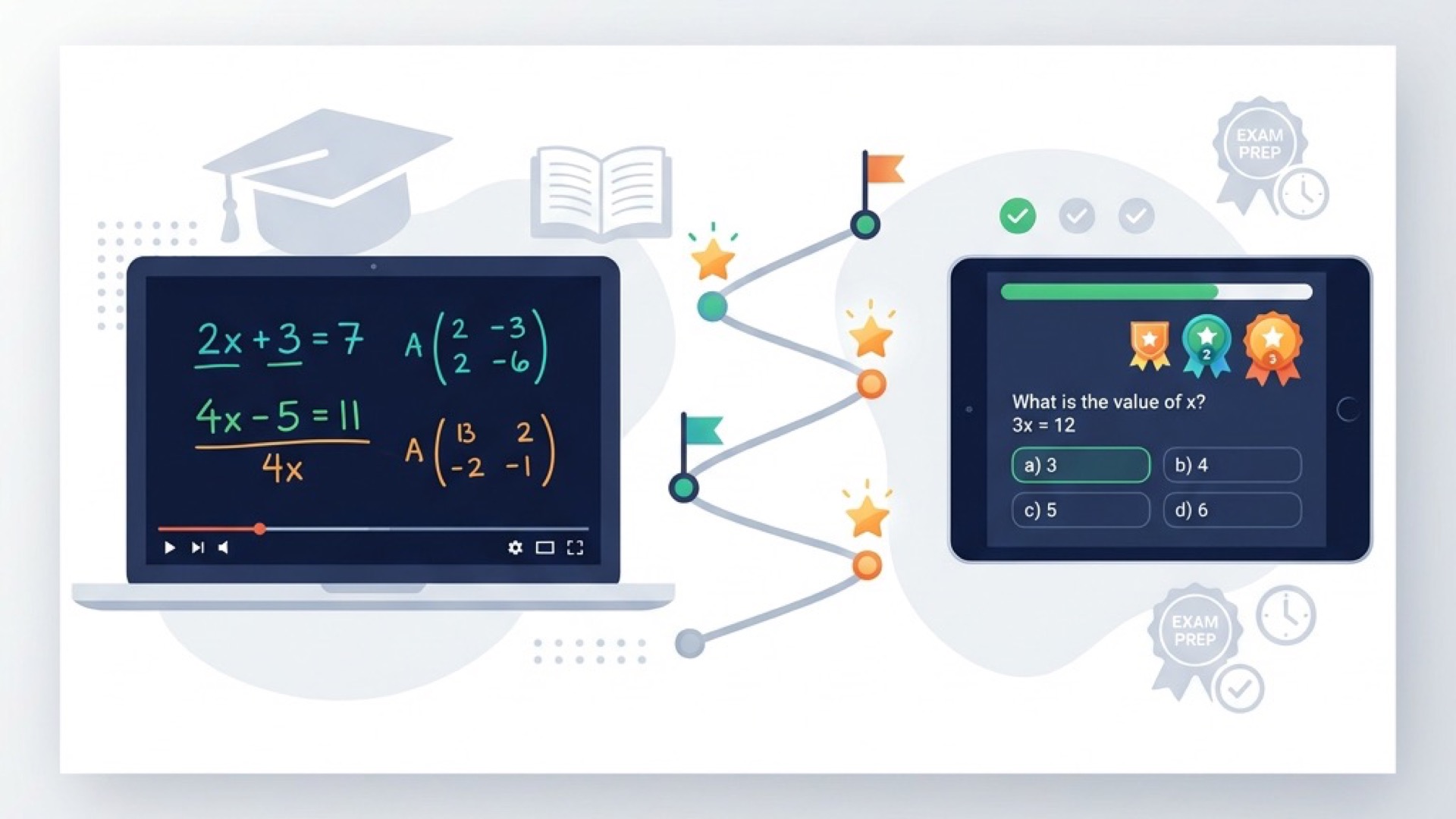
Khan Academy math learning platform showing algebra video tutorial on laptop with mastery-based practice problems, progress tracking path, and SAT AP exam prep badges
Best For:K-12 students, college prep, and SAT/AP exam readiness

Khan Academy remains the gold standard for free math education. Its mastery-based learning paths adapt to your level, ensuring you fully understand each concept before advancing. The platform covers everything from basic arithmetic through AP Calculus and Linear Algebra, with thousands of practice problems and video tutorials.

The 2026 addition of Khanmigo, an AI-powered tutor built on GPT-4, transforms the experience. Instead of giving answers, Khanmigo asks guiding questions to help you arrive at solutions yourself. Official SAT and AP exam prep modules make it indispensable for US students.

Khan Academy works on iOS, Android, and web. Every feature is completely free with no premium tier, funded by donations.

Strengths

  • Completely free with no ads or premium paywalls
  • Mastery-based progression prevents gaps in understanding
  • Official SAT, AP, and LSAT prep included
  • Khanmigo AI tutor provides personalized guidance
  • Progress tracking for parents and teachers

Limitations

  • Interface can feel dated compared to newer apps
  • Khanmigo AI requires a separate (paid) subscription
  • Video-heavy format may not suit hands-on learners
Start Learning Free
2

Photomath: Best Camera-Based Homework Helper

Scan any equation for instant step-by-step solutions

Editor Rating
4.8
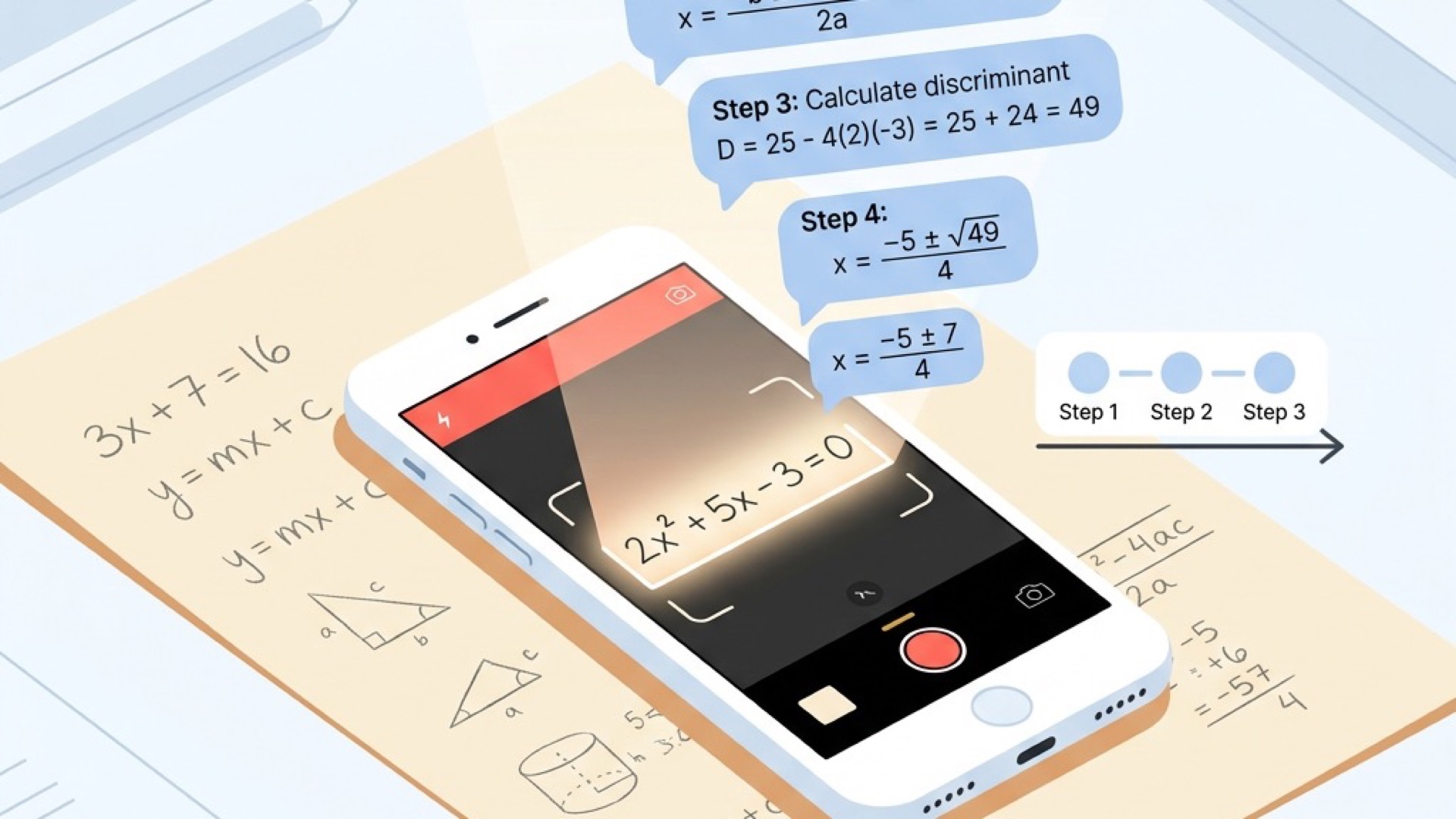
Smartphone camera scanning a handwritten quadratic equation on paper with step-by-step solution bubbles showing coefficient identification, quadratic formula substitution, and final answer
Best For:K-12 students and quick homework verification

Photomath pioneered the math solver scanner category and remains the most polished option in 2026. Point your camera at a handwritten or printed equation, and the app provides instant solutions with animated step-by-step walkthroughs. The OCR engine handles everything from basic arithmetic to integrals and matrix equations.

What sets Photomath apart from simple answer engines is its teaching approach. Each step includes an explanation of the mathematical principle being applied, helping students learn the method rather than just copy the answer. The app works offline for basic problems, making it useful during exams or in areas with poor connectivity.

Photomath is free for basic scanning and solutions. Photomath Plus (subscription) unlocks animated tutorials, custom AI explanations, and textbook-specific solutions.

Strengths

  • Exceptional OCR for handwritten notes and textbooks
  • Animated step-by-step tutorials explain each principle
  • Works offline for basic problems
  • Covers arithmetic through calculus and linear algebra

Limitations

  • Advanced animated tutorials require Photomath Plus subscription
  • Can struggle with multi-line integrals and complex notation
  • Risk of over-reliance if used only to copy answers
Try Photomath Free
3

IXL: Best for Curriculum-Aligned School Practice

Tracks progress against specific grade-level standards

Editor Rating
4.6
Best For:Students needing structured, school-aligned practice with progress tracking

IXL is the most comprehensive curriculum-aligned math practice platform available. It maps directly to state and national standards (Common Core, TEKS, Australian Curriculum, UK National Curriculum), making it the top choice for parents and teachers who want structured practice that mirrors what students learn in school.

The platform covers pre-K through 12th grade with thousands of skills organized by grade and topic. Its diagnostic system identifies gaps in understanding and recommends targeted practice. Real-time analytics show exactly which concepts a student has mastered and which need reinforcement.

IXL requires a subscription, but schools often provide institutional access. The depth of curriculum alignment and progress reporting justifies the cost for serious academic improvement.

Strengths

  • Curriculum-aligned to major national and state standards
  • Comprehensive diagnostic identifies knowledge gaps
  • Detailed progress reports for parents and teachers
  • Covers pre-K through 12th grade math

Limitations

  • Requires paid subscription (no free tier beyond limited daily questions)
  • Interface prioritizes function over engagement for younger kids
  • Can feel repetitive without variety in question types
Explore IXL
4

Brilliant.org: Best for Deep STEM Intuition

Interactive puzzles that build real mathematical thinking

Editor Rating
4.8
Best For:Adults, professionals, and anyone building deep STEM thinking skills

Brilliant.org takes a fundamentally different approach to math education. Instead of watching videos and solving textbook problems, you work through interactive puzzles and challenges that build intuition from the ground up. The platform calls this "active learning," and research supports that it produces deeper understanding than passive content consumption.

The app covers foundational math, logic, statistics, computer science, and even quantum mechanics. Each course is built around visual, hands-on challenges that make abstract concepts tangible. For adults returning to math or professionals looking to strengthen analytical thinking, Brilliant is unmatched.

Brilliant requires a subscription, but the quality of content is exceptional. The free tier offers a limited number of challenges daily.

Strengths

  • Interactive puzzles build genuine mathematical intuition
  • No passive video watching, only hands-on challenges
  • Covers math, logic, CS, data science, and physics
  • Beautiful visual design makes complex topics accessible

Limitations

  • Subscription is relatively expensive (monthly or annual)
  • Free tier is very limited (a few challenges per day)
  • Not aligned to specific school curricula
Try Brilliant Free
5

Elevate: Best for Professional Math Agility

Daily brain training focused on real-world number skills

Editor Rating
4.5
Best For:Professionals sharpening estimation, percentages, and data skills

Elevate is a brain training app that focuses on practical math skills used in professional and daily life. Instead of abstract equations, it trains estimation, percentage calculations, tip splitting, data interpretation, and unit conversion. Each session is personalized based on your performance.

The app delivers bite-sized daily training sessions (5 to 10 minutes) that fit easily into a commute or lunch break. Progress is tracked across multiple cognitive dimensions including precision, speed, and recall. Apple named Elevate its App of the Year, and it remains one of the most polished brain training experiences available.

Elevate is freemium. The free version offers limited daily training, while Pro unlocks all exercises and detailed performance analytics.

Strengths

  • Focuses on practical, real-world math skills
  • Short daily sessions (5 to 10 minutes) fit any schedule
  • Beautiful, polished interface and UX
  • Tracks performance across multiple cognitive dimensions

Limitations

  • Pro subscription required for full access
  • Not designed for academic math (no algebra, calculus)
  • Some exercises feel more like puzzles than math training
Download Elevate
6

Paul's Online Math Notes: Best Free Advanced Reference

Rigorous text-based resource for calculus and beyond

Editor Rating
4.7
Best For:University students in Calculus I through III and Differential Equations

Paul's Online Math Notes is not an app in the traditional sense. It is a legendary free web resource created by Paul Dawkins at Lamar University that covers Algebra, Calculus I through III, and Differential Equations with extraordinary depth and clarity.

What makes this resource exceptional is the combination of thorough explanations, fully worked examples, and practice problems with solutions. Every concept includes multiple examples that progress from simple to complex. For university students struggling with calculus, this is often the resource that finally makes things click.

The site is entirely free, ad-supported, and requires no account. It works on any device with a web browser. While the design is utilitarian, the mathematical content is world-class.

Strengths

  • Completely free with no registration required
  • Covers Algebra through Differential Equations in exceptional depth
  • Every concept includes multiple fully worked examples
  • Practice problems with complete solutions

Limitations

  • Web-only with no dedicated mobile app
  • Utilitarian design with no interactive elements
  • No AI tutoring or adaptive learning features
  • Does not cover statistics, discrete math, or linear algebra
Visit Paul's Online Math Notes
7

FastMath (iOS) and Math Workout (Android): Best Speed Drills

Daily arithmetic drills with leaderboards and timers

Editor Rating
4.3
Best For:Daily mental math speed training and arithmetic fluency

For pure mental math speed improvement, FastMath (iOS) and Math Workout (Android) deliver focused daily drill sessions. Both apps follow the same philosophy: rapid-fire arithmetic problems under time pressure, with difficulty that adapts to your performance.

FastMath features a clean, distraction-free interface with customizable difficulty levels for addition, subtraction, multiplication, and division. High-score leaderboards add a competitive element that motivates daily practice. Math Workout on Android offers similar functionality with timed challenges and progress streaks.

Both apps are free or very low cost. Sessions take 5 to 10 minutes, making them ideal for daily warm-ups or commute training.

Strengths

  • Focused exclusively on arithmetic speed improvement
  • Customizable difficulty from basic to advanced
  • High-score leaderboards add competitive motivation
  • Sessions take only 5 to 10 minutes

Limitations

  • Limited to basic arithmetic (no algebra, geometry, or calculus)
  • FastMath is iOS-only; Math Workout is Android-only
  • No step-by-step explanations when you get answers wrong
Search FastMath on App Store
8

Mental Math Master: Best for Advanced Mental Tricks

Learn shortcuts for square roots, logarithms, and large multiplication

Editor Rating
4.4
Best For:Enthusiasts who want to perform complex calculations mentally

Mental Math Master goes beyond basic arithmetic drills to teach advanced mental calculation techniques. The app covers tricks for rapidly computing square roots, estimating logarithms, multiplying large numbers, and performing complex percentage calculations entirely in your head.

Each technique is taught through a structured lesson followed by timed practice. The app explains the mathematical reasoning behind each shortcut, so you understand why the tricks work rather than just memorizing procedures. Difficulty progresses from intermediate techniques (two-digit multiplication) to expert-level challenges (three-digit squares).

Available on both iOS and Android, the app offers a free tier with basic techniques and a premium unlock for advanced modules.

Strengths

  • Teaches advanced mental math techniques beyond basic arithmetic
  • Explains the reasoning behind each shortcut
  • Structured progression from intermediate to expert level
  • Covers square roots, logarithms, and complex multiplication

Limitations

  • Steeper learning curve than basic drill apps
  • Premium required for advanced technique modules
  • Smaller community and fewer updates than mainstream apps
Try Mental Math Master
9

Mathemagics: Best for Calculation Shortcuts

Learn specific tricks to solve large problems in seconds

Editor Rating
4.2
Best For:Learning specific mental math tricks for speed and showmanship

Mathemagics is inspired by the techniques of "mathemagicians" like Arthur Benjamin who perform seemingly impossible calculations on stage. The app teaches specific shortcuts for multiplying numbers near 100, squaring two-digit numbers, and computing calendar dates mentally.

The app presents each trick as a mini-lesson with visual demonstrations, then provides practice problems to internalize the technique. It is less of a comprehensive math education tool and more of a focused collection of impressive calculation shortcuts that build number sense.

Available on iOS with a one-time purchase price. No subscription, no ads, and no in-app purchases.

Strengths

  • Teaches impressive, practical calculation shortcuts
  • One-time purchase with no subscription or ads
  • Visual demonstrations make techniques easy to follow
  • Builds genuine number sense and mathematical confidence

Limitations

  • iOS only (no Android version)
  • Limited scope: shortcuts only, not comprehensive education
  • Content has not been significantly updated recently
Get Mathemagics
10

Prodigy Math: Best Gamified Experience for Kids

An RPG where math problems power your character

Editor Rating
4.5
Best For:Kids aged 6 to 14 who need motivation to practice math daily

Prodigy Math transforms math practice into a full role-playing game (RPG). Students create a character, explore a fantasy world, battle monsters, and collect items. The twist: every battle requires solving grade-appropriate math problems to cast spells and defeat enemies.

The game covers grades 1 through 8 and aligns with Common Core, TEKS, and other major curricula. Teachers can assign specific topics, and the adaptive algorithm adjusts difficulty based on student performance. For kids who resist traditional math practice, Prodigy is often the breakthrough that makes daily practice enjoyable.

The core game is free. A paid membership unlocks additional items, worlds, and parent reporting features, but all math content is accessible in the free version.

Strengths

  • Full RPG experience makes math practice genuinely fun for kids
  • Curriculum-aligned for grades 1 through 8
  • Adaptive difficulty adjusts to each student's level
  • Free access to all math content (paid tier is cosmetic upgrades)

Limitations

  • Game elements can distract from focused math practice
  • Paid membership pressure through in-game item incentives
  • Not suitable for high school or advanced math topics
Play Prodigy Free
11

DragonBox Series: Best for Sneaky Algebra and Geometry

Teaches real math concepts through pure gameplay

Editor Rating
4.6
Best For:Kids aged 5 to 14 learning algebra and geometry intuitively

DragonBox takes a radically different approach to math education: it teaches algebra and geometry concepts through abstract gameplay without ever showing a traditional equation. Players manipulate visual objects, balance scales, and build shapes, and only gradually realize they have been solving real algebraic equations the entire time.

The series includes DragonBox Algebra (ages 5 and up), DragonBox Algebra 12+ (pre-algebra and algebra), and DragonBox Elements (geometry based on Euclid's Elements). Research published in educational journals has shown that students using DragonBox develop algebraic intuition significantly faster than control groups.

All DragonBox apps are paid (one-time purchase). There are no subscriptions, no ads, and no in-app purchases.

Strengths

  • Teaches real algebra and geometry through pure gameplay
  • Research-backed effectiveness in building algebraic intuition
  • No ads, no subscriptions, no in-app purchases
  • Multiple titles covering ages 5 through 14

Limitations

  • One-time purchase required for each title
  • Limited replay value once concepts are mastered
  • Not aligned to specific school curricula or testing
Explore DragonBox
12

Calculory Math Games: Best Free Browser-Based Practice

Instant math games with no downloads or sign-up

Editor Rating
4.7
Best For:Quick, free math practice on any device without installation

For quick, free math practice that requires no app installation, Calculory's built-in math games offer instant browser-based training across arithmetic, algebra, fractions, percentages, and more. Games like Arithmetic Sprint, Mental Math Marathon, and Equation Balancer provide timed challenges that build speed and accuracy.

Each game tracks your score and adapts difficulty in real time. Because they run in the browser, they work on any device (phone, tablet, laptop) with zero setup. Pair them with Calculory's free calculators for a complete learning loop: practice with games, verify with calculators, and understand with step-by-step solutions.

All Calculory math games are completely free with no account required.

Strengths

  • Completely free with no sign-up or download required
  • Works on any device with a web browser
  • Covers arithmetic, algebra, fractions, percentages, and geometry
  • Pairs with free calculators for a complete learning loop

Limitations

  • Requires internet connection (no offline mode)
  • Fewer game titles than dedicated apps like Prodigy
  • No RPG or narrative elements for younger kids
Play Math Games Free

Expert Tips: How to Stay Consistent with Math Practice

Choosing the right app is only half the battle. Consistent daily practice is what actually builds math fluency. Here are three research-backed strategies:

The 15-Minute Rule

Cognitive science research consistently shows that short, daily practice sessions outperform longer weekly sessions for skill retention. Fifteen minutes of focused math practice every day builds stronger neural pathways than a 90-minute weekend cramming session. Set a daily alarm and treat it like brushing your teeth.

Mix Theory and Practice

The most effective approach combines conceptual learning with speed training. Use Khan Academy or Brilliant for understanding the "why" behind a topic, then immediately drill with FastMath, Arithmetic Sprint, or Mental Math Marathon to build fluency. Theory without practice leads to shallow understanding; practice without theory leads to fragile skills.

Use Offline and Commute Time

Many apps (Photomath, Khan Academy, Elevate) offer offline modes. Download lessons and problem sets before your commute, then practice during transit. Even 10 minutes of mental math drills on the bus compounds into hours of practice per month. Apps like FastMath are designed specifically for these quick, offline sessions.

StrategyWhy It WorksBest Apps
15-minute daily sessionsSpaced repetition strengthens long-term memoryAny app with daily streaks (Brilliant, Elevate, IXL)
Mix theory and speed drillsCombines understanding with automaticityKhan Academy + FastMath or Calculory Games
Offline commute practiceCaptures otherwise wasted timePhotomath, Khan Academy (downloaded), FastMath

Choosing Your Perfect Match

The best math training app depends entirely on your goals, age, and learning style. Here is a quick decision framework:

Students (K-12): Start with Khan Academy for structured learning. Add Photomath for homework help and Prodigy for daily motivation.

University students: Use Paul's Online Math Notes for calculus and differential equations. Supplement with Brilliant for building deeper intuition.

Adults and professionals: Brilliant for deep STEM thinking, Elevate for practical daily math, or Mental Math Master for impressive mental calculation skills.

Parents looking for kids' apps: DragonBox for younger children (ages 5 to 10), Prodigy for older kids (ages 8 to 14), and Calculory Games for quick browser-based practice.

Speed enthusiasts: FastMath or Math Workout for daily drills, Mathemagics for advanced shortcuts, and Mental Math Marathon for timed challenges.

The most important factor is consistency. A mediocre app used daily will produce better results than the perfect app used once a week. Pick one that matches your goal, commit to 15 minutes a day, and watch your math fluency grow.

Frequently Asked Questions

What is the best free math app for students in 2026?

Khan Academy is the best completely free math app for students. It covers K-12 through college-level math with mastery-based learning paths, video tutorials, and official SAT and AP exam prep. Every feature is free with no premium tier. For quick homework help, Photomath offers free camera scanning and basic step-by-step solutions.

Which math app is best for adults who want to improve?

Brilliant.org is the best math app for adults. It uses interactive puzzles and hands-on challenges to build genuine mathematical intuition, covering topics from foundational math through data science and physics. For practical everyday math skills like estimation and percentages, Elevate offers short daily brain training sessions designed for professionals.

Can math training apps actually improve your skills?

Yes. Research in cognitive science shows that consistent daily practice with adaptive difficulty produces measurable improvements in mathematical fluency. The key is daily consistency (15 minutes per day) and mixing conceptual learning with speed drills. Apps that adapt to your level, like Khan Academy, IXL, and Brilliant, are more effective than static problem sets.

What is the best math app for mental math speed?

FastMath (iOS) and Math Workout (Android) are the best apps for pure arithmetic speed training. For advanced mental calculation techniques like square roots and large multiplication, Mental Math Master and Mathemagics teach specific shortcuts. Calculory's free Mental Math Marathon game offers browser-based speed challenges with no download required.

Are gamified math apps effective for children?

Yes, when used correctly. Research shows that gamified math apps like Prodigy and DragonBox increase engagement and practice time, which leads to better outcomes. DragonBox in particular has published research showing accelerated algebraic understanding. The key is ensuring the game rewards correct math work, not just playtime.

Is it better to use one math app or multiple apps?

Using two to three complementary apps is more effective than relying on one. The optimal combination pairs a conceptual learning platform (Khan Academy or Brilliant for understanding) with a speed drill app (FastMath or Calculory Games for fluency). This mirrors the way musicians practice: learning theory and then drilling technique.

How much time should I spend on math practice apps daily?

Research suggests 15 to 20 minutes of focused daily practice is the sweet spot for most learners. This is long enough to make meaningful progress but short enough to maintain consistency. Short daily sessions outperform longer weekly sessions because spaced repetition strengthens long-term memory more effectively than massed practice.

Author Spotlight

The Calculory Team

Content and Research

We make essential math and science concepts accessible with clear explanations, worked examples, and free online calculators. Our team tests every tool we recommend.

Verified Expert Educator
math appsbest math appmath trainingmath app for studentsmath app for adultsmental math appfree math applearn math appmath practice appmath gameseducation2026