Sustainability6 min readUpdated Apr 25, 2026

EV vs Gas TCO 2026: When Electric Actually Pays Off

The Calculory Team

Transportation Economics and EV Cost Analysis

Stop comparing EVs and gas cars on sticker price. The 2026 TCO model nets out the federal credit, fuel, maintenance, and residual value to give years to parity.

EV vs Gas TCO 2026: When Electric Actually Pays Off

Key Takeaways

  • For most US drivers covering 10,000 to 15,000 miles per year and holding 5 or more years, EVs are cheaper to own than comparable gas cars in 2026.
  • The federal Section 30D credit is up to $7,500 at the point of sale on qualifying new EVs assembled in North America.
  • EV fuel cost runs $0.04 to $0.05 per mile at home charging vs $0.10 to $0.13 for a 30 mpg gas car.
  • EV maintenance averages $300 to $500 per year vs $900 to $1,500 for a comparable gas car, per AAA and Consumer Reports.
  • Residual value is the single biggest TCO variable. Tesla holds 50 to 60 percent after 5 years, most other EVs land at 40 to 50 percent.
  • Used EVs in 2026 often beat both new and used gas cars on day one due to depreciation curves, with the federal $4,000 used EV credit on top.

Quick Comparison

1

Why EV vs Gas Math Changed in 2026

EV economics in 2026 are dramatically different from 2022. The federal Section 30D Clean Vehicle Credit is now applied at the point of sale by participating dealers, meaning the $7,500 comes off the sticker on the spot rather than waiting for a tax return. Manufacturing has scaled, sticker prices on mainstream EVs have stabilized, and the used EV market is producing genuine bargains.

Meanwhile, gas prices have stayed at $3.30 to $3.80 per gallon in most US markets, and gas car maintenance costs have risen as vehicles get more electronically complex.

Variable2022 Reality2026 Reality
Federal EV creditFiled at tax timePoint-of-sale rebate
Mainstream EV price$45,000 to $60,000$35,000 to $55,000
EV residual at year 530 to 40 percent40 to 60 percent
Used EV marketTinyStrong, with $4,000 used credit

Use the EV Total Cost of Ownership Calculator to model your specific pair of vehicles and see your years to parity.

EV vs Gas TCO Visual Overview

EV versus gas total cost of ownership overview showing electric and gas cars compared through fuel, maintenance, federal credit, residual value, and break-even savings.
2

The TCO Formula and Cost Build-Up

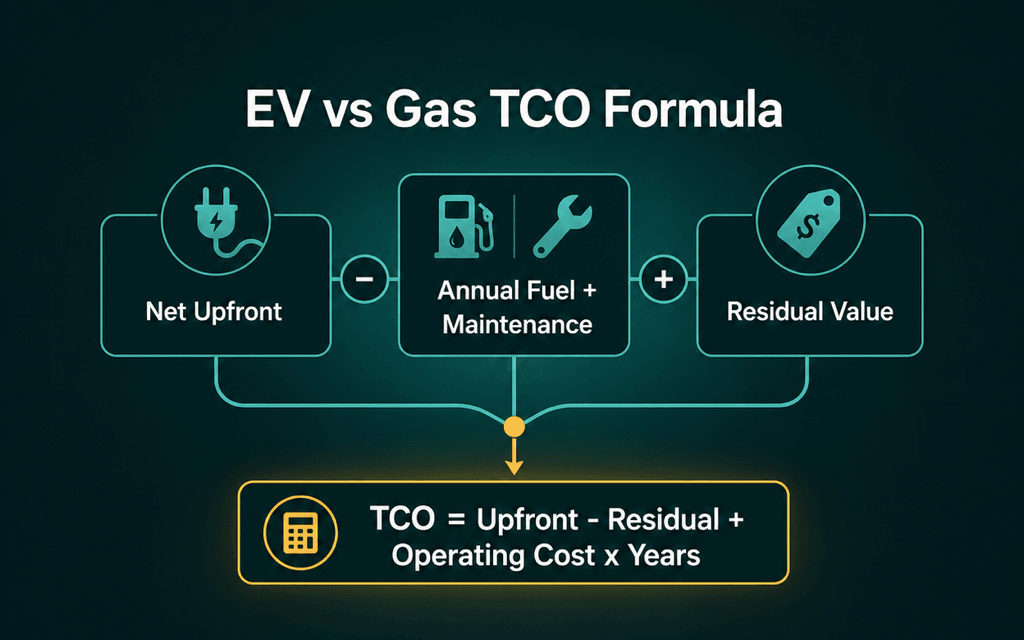
Infographic showing the EV vs gas total cost of ownership formula built from net upfront cost, annual fuel and maintenance, residual value, and ownership years.

True total cost of ownership has three components for each vehicle: net upfront cost, total operating cost over the holding period, and residual value at the end.

Variables

  • P = Sticker price
  • C = Federal tax credit
  • Rrebate = State or utility rebate
  • Y = Ownership years
  • M = Annual miles
  • E = Efficiency (mpg for gas, mi/kWh for EV)
  • Pfuel = Fuel price ($/gallon or $/kWh)
  • Mann = Annual maintenance
  • Vresidual = Residual value at end of holding period

Step 1: Net Upfront

Net Upfront = P - C - Rrebate

Step 2: Annual Fuel Cost

Annual Fuel = (M / E) x Pfuel

Step 3: Total Cost of Ownership

TCO = Net Upfront - Vresidual + (Annual Fuel + Mann) x Y

Step 4: Years to Parity

Years to Parity = (EV Net Upfront - Gas Net Upfront) / (Annual Operating Savings)

OutputMeaningDecision Use
Net upfrontWhat you actually spend after creditsTrue purchase comparison
Annual fuelYearly fuel or charging costOperating efficiency check
TCOFull cost over your holding periodHeadline buy decision
Years to parityWhen EV operating savings cover the upfront premiumHold-period sanity check

For broader sustainability spending decisions, layer in the Circular TCO Calculator which uses the same Linear vs Circular framework on any large purchase.

3

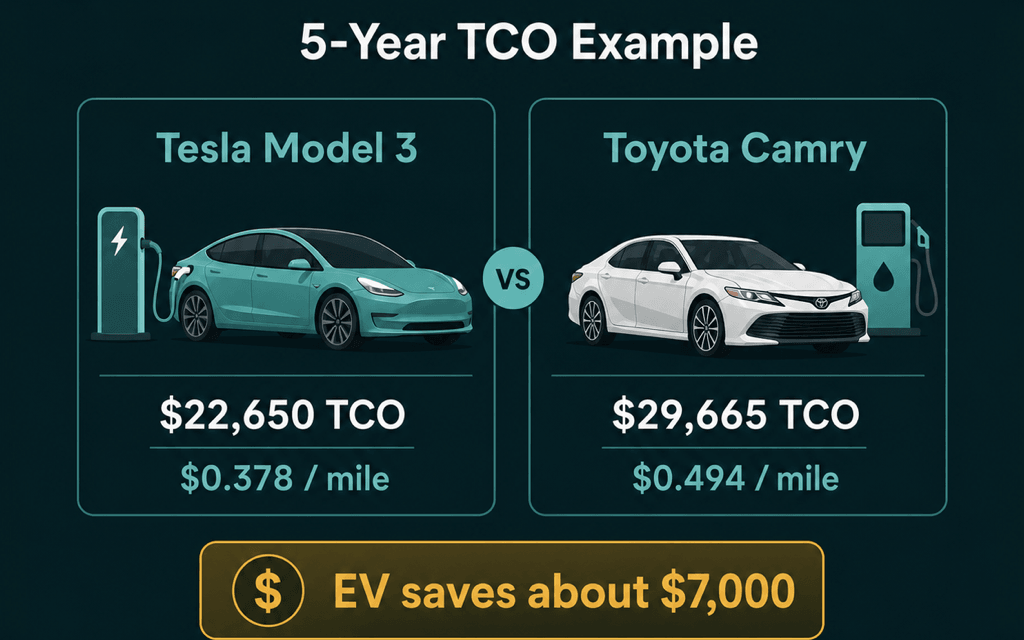
Sample Use Case: Tesla Model 3 vs Toyota Camry

Side-by-side infographic comparing a Tesla Model 3 and Toyota Camry 5-year total cost of ownership, showing $22,650 versus $29,665 and about $7,000 in EV savings.

The most common 2026 EV vs gas comparison is the Tesla Model 3 against the Toyota Camry. Similar size, similar segment, similar buyer.

Scenario assumptions:

  • Tesla Model 3: $42,000 sticker, $7,500 federal credit, $0 state rebate, 4.0 mi/kWh efficiency
  • Toyota Camry: $28,500 sticker, no credit, 32 mpg combined
  • Holding period: 5 years
  • Annual miles: 12,000
  • Gas: $3.50/gallon, electricity: $0.16/kWh
  • Maintenance: EV $400/yr, Camry $1,200/yr
  • Residual: Tesla 50% of net upfront, Camry 40% of sticker
  • Insurance: EV $200/yr more
VariableTesla Model 3Toyota Camry
Net upfront$34,500$28,500
Annual fuel$480$1,313
Annual maintenance$400$1,200
Annual insurance gap+$200baseline
Residual after 5 years$17,250$11,400
5-year TCO$22,650$29,665
Cost per mile$0.378/mi$0.494/mi
Years to parity~3.7 years

The Tesla saves about $7,000 over 5 years and reaches cost parity in under 4 years. After that, it is pure savings.

4

Why Residual Value Drives EV Economics

Residual value at the end of your ownership period is the single largest TCO variable for EVs. A 10 percentage point difference in residual at year 5 swings TCO by $3,000 to $5,000.

Brand5-Year Residual (% of net upfront)Why
Tesla50 to 60 percentStrong brand, OTA updates, supercharger access
Hyundai / Kia45 to 55 percentImproving build quality, good warranty
Ford40 to 50 percentMach-E and Lightning hold value, F-150 strong
GM35 to 45 percentMixed depreciation history, improving with Ultium
Rivian50 to 60 percentStrong demand, limited supply
Lucid30 to 40 percentBrand still building, fast depreciation

The lesson: brand matters more in EVs than in gas cars because battery health concerns weigh on resale, and brands with proven battery longevity command a premium. Run the Repair vs Replace Calculator if you are weighing buying a new EV against keeping a gas car you already own and just maintaining it.

5

Hidden EV Costs Most Buyers Forget

Three categories of EV cost are often underestimated and can swing TCO by $2,000 to $5,000 over a 5-year hold.

Hidden CostTypical RangeHow to Budget
Home charger install$500 to $2,500 one-timeAdd to EV upfront for honest comparison
Insurance premium$100 to $400 more per year vs gasGet quotes on both before deciding
Tire replacement frequency30 to 50 percent more often than gasBudget extra $200 to $400 per year on long holds
DC fast charging on road trips$0.40 to $0.55 per kWh vs $0.16 at homeEstimate 10 to 20 percent of miles on DCFC

None of these kill the EV economic case for most buyers, but they do tighten the gap. The calculator includes the insurance line item directly. Charger install can be added to the EV sticker price input for a fully honest comparison.

6

When Gas Still Wins in 2026

EVs do not win every comparison. Several common scenarios still favor a gas vehicle, and the calculator will tell you so honestly.

  • Annual mileage under 8,000 (operating savings cannot cover upfront premium fast enough)
  • Holding period under 4 years (residual depreciation hits hard)
  • Highly seasonal use (camping, RV towing) where range and charging are awkward
  • No home charging (DC fast charging eliminates most fuel savings)
  • Buying a used gas car under $15,000 (very hard for a new EV to beat)
  • Specialty use cases like heavy-duty towing where EV range collapses under load
ScenarioWhy Gas WinsApproximate Threshold
Low miles, short holdOperating savings smallUnder 8,000 mi/yr, under 4 years
Apartment dweller, no chargerDC fast charging is 3x home rateOver 60% of miles on public DCFC
Heavy towingEV range drops 40 to 50 percentTow over 5,000 lbs more than 30 days a year
Used car shopper under $15KEV inventory thin in this bandBudget under $15,000 for the car

For specific situations, the Solar Payback Calculator becomes relevant if home charging would let you pair an EV with rooftop solar and drop your effective fuel cost to near zero.

7

pSEO Modifiers for Scaling 100+ EV Decision Pages

EV vs gas is a high-volume search topic with strong vertical opportunities. The intent is precise (specific make and model comparisons) and time-sensitive (rebates and credits change).

Modifier AxisValuesTemplate Pattern
By EV ModelTesla Model 3, Model Y, Hyundai Ioniq 5, Kia EV6, Ford Mach-E, F-150 Lightning, Chevy Equinox EV, Rivian R1T[EV Model] vs [Gas Equivalent] TCO
By Use CaseCommuter, Family, Truck, Rideshare, FleetEV vs Gas TCO for [Use Case]
By Annual Miles10K, 15K, 20K, 30K (high-mileage rideshare)EV Payback at [Miles] Miles per Year
By StateCA, TX, NY, FL, MA (rebate amounts vary)EV TCO in [State] with State Rebates

State pages compound nicely with utility EV charging plans (PG&E EV-A, ConEd EV) which can cut home charging cost by 30 to 50 percent and accelerate parity by a year.

8

Conclusion: EVs Are a Math Win for Most US Drivers

In 2026, the EV vs gas decision has crossed from values-driven to math-driven for most mainstream buyers. The federal credit at point of sale, dropping sticker prices, dramatically lower fuel and maintenance costs, and improving residual values combine to make EVs cheaper over a 5-year hold for any driver covering 10,000-plus miles per year.

The winning approach is to model your specific pair of vehicles, your actual annual mileage, your local electricity rate, and your honest holding period. The headline numbers you actually need are 5-year TCO and years to parity. Most popular EV vs gas pairings now deliver 3 to 5 years to parity, which is the new normal.

Frequently Asked Questions

How is EV total cost of ownership calculated?

Net upfront is sticker price minus federal Section 30D credit (up to $7,500) and state or utility rebates. Annual operating cost is annual fuel (miles divided by efficiency times fuel price) plus annual maintenance plus insurance gap. Total TCO is net upfront minus residual value at end of hold, plus operating cost multiplied by ownership years. Compare both vehicles using the same formula.

Is an EV cheaper than a gas car in 2026?

For most US drivers covering 10,000 to 15,000 miles per year and holding 5 or more years, yes. Federal credit of $7,500, fuel savings of $700 to $1,500 per year, and maintenance savings of $500 to $1,000 per year typically overcome the higher sticker price within 3 to 5 years. Lower-mileage drivers and short holds can flip the math.

Does the $7,500 federal EV tax credit still apply in 2026?

Yes. Section 30D applies to qualifying new EVs assembled in North America with battery and mineral sourcing requirements. In 2026 most popular EVs from Tesla, Ford, GM, Hyundai, Honda, and Stellantis qualify for the full $7,500. The credit is now applied as a point-of-sale rebate at participating dealers, taking $7,500 off the sticker on the spot.

What about the used EV credit?

Section 25E provides up to $4,000 (or 30 percent of sale price, whichever is lower) for used EVs sold for under $25,000 by a licensed dealer. The buyer must meet income limits and the EV must be at least 2 model years old. This makes used EVs in 2026 often the cheapest TCO option overall.

How much does it cost to charge an EV vs fill a gas tank?

A typical EV uses about 30 kWh per 100 miles. At home electricity rates of $0.13 to $0.17 per kWh, that costs $4 to $5 per 100 miles. The same 100 miles in a 30 mpg gas car at $3.50 per gallon costs $11.67. Home charging cuts fuel cost by roughly 60 to 70 percent. Public DC fast charging costs $12 to $16 per 100 miles.

Are EV maintenance costs really lower?

Yes, materially. EVs have no oil changes, no transmission service, no exhaust system, no spark plugs, and dramatically less brake wear thanks to regenerative braking. Annual maintenance averages $300 to $500 for an EV vs $900 to $1,500 for a comparable gas vehicle, per Consumer Reports and AAA. Tires are the one cost that runs higher on EVs.

What is the biggest mistake EV buyers make?

Comparing sticker prices instead of TCO. The federal credit, fuel savings, and maintenance savings only become visible across a multi-year hold. Buyers who compare $42,000 EV vs $28,500 gas car and stop there miss the $7,500 credit and the $1,500 per year operating gap. Run the full TCO over your real holding period to see the true cost.

Author Spotlight

The Calculory Team

Transportation Economics and EV Cost Analysis

We model the real cost of vehicle ownership across electric and gas options so buyers can decide on math, not marketing.

Verified Expert Educator
ev vs gas total cost of ownershiptesla model 3 vs camry tcofederal ev tax credit 2026ev cost per mileev maintenance costelectric vehicle break-evenused ev tax creditev residual valueev tco calculatorsustainable transport economics2026