Health5 min readUpdated Apr 3, 2026

How to Calculate Corrected Age for Premature Babies

The Calculory Team

Health Content and Research

Learn how to calculate corrected age for premature babies using birth date, due date, and weeks early. Includes step-by-step examples and milestone guidance.

How to Calculate Corrected Age for Premature Babies

Key Takeaways

  • Corrected age adjusts a premature baby's age by subtracting how many weeks early they were born.
  • Chronological age and corrected age are not the same. Premature babies often need corrected age for milestone tracking.
  • A baby born 8 weeks early who is 6 months old chronologically has a corrected age of about 4 months.
  • Corrected age matters most for developmental milestones like smiling, rolling, sitting, crawling, and early speech.
  • Most clinicians use corrected age until at least 2 years old, and sometimes up to 3 years for very preterm babies.
  • Corrected age is a developmental tool, not a replacement for pediatric guidance.

What Is Corrected Age for a Premature Baby?

Corrected age, also called adjusted age, is the age a premature baby would be if they had been born on their original due date instead of early. It gives parents and clinicians a fairer way to compare development with expected milestones.

This matters because premature babies have had less time to grow before birth. If you compare them only by their actual birthday, they may appear behind when they are actually developing appropriately for how early they were born.

TermMeaningWhy It Matters
Chronological ageTime since the actual birth dateUsed for birthdays, records, and school age
Corrected ageChronological age minus weeks born earlyUsed for developmental milestone tracking

For a quick estimate based on birth date and due date, use the Corrected Age Calculator.
How Do You Calculate Corrected Age?

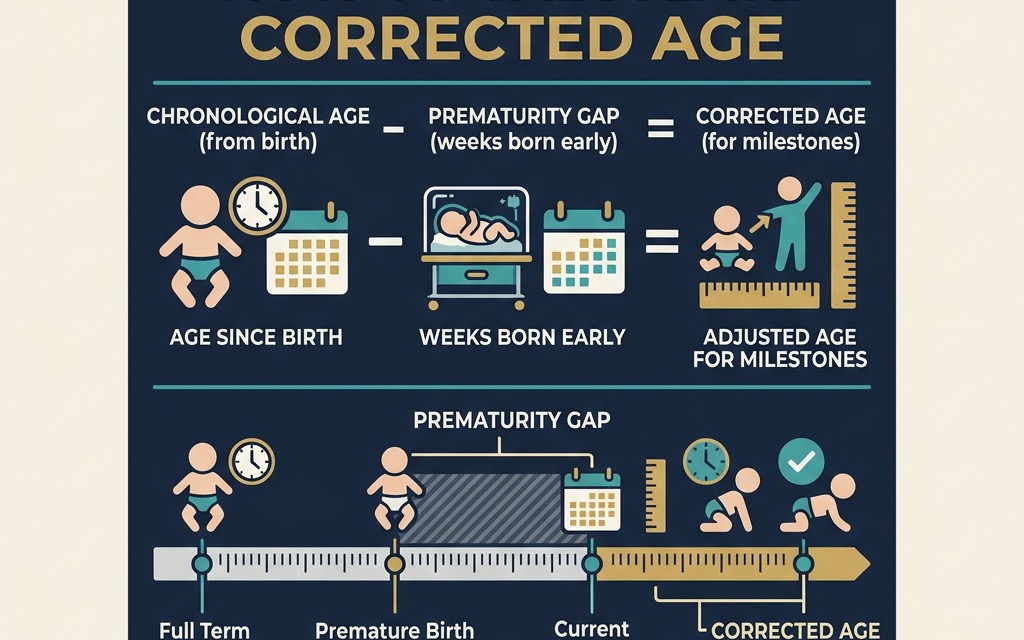
A 'How to Calculate Corrected Age' infographic showing the formula: Chronological Age minus Prematurity Gap equals Corrected Age.

The basic formula is straightforward:

  1. 1.Find the baby's chronological age.
  2. 2.Calculate how many weeks early the baby was born.
  3. 3.Subtract the weeks early from the chronological age.

That gives you the corrected age.

StepCalculationExample
1Chronological age6 months since birth
2Weeks early8 weeks early
3Corrected age6 months - 8 weeks = about 4 months

In simple terms, corrected age answers this question: "If my baby had arrived on the due date, how old would they be today?"

Key insight: Corrected age is not changing the baby's real birthday. It is only changing the developmental comparison point.

Step-by-Step Example of Corrected Age

Let us use a full worked example. Imagine a baby was due on June 1 but was born on April 6. That baby arrived 8 weeks early.

Now imagine today is October 6. From April 6 to October 6, the baby is 6 months old chronologically. But because the baby was born 8 weeks early, you subtract those 8 weeks from the 6-month age.

Timeline ItemDate or Value
Original due dateJune 1
Actual birth dateApril 6
Born early by8 weeks
Chronological age on October 66 months
Corrected age on October 6About 4 months

That means if you are checking a milestone like rolling or social smiling, you should usually compare the baby to what is typical for a 4-month-old, not a 6-month-old.

If you need help separating real age from adjusted developmental age, the Chronological Age Calculator can help you find the exact age on any date before you make the corrected-age adjustment.

How Many Weeks Early Was My Baby?

To calculate corrected age accurately, you need to know how early the baby was born. The easiest way is to compare the actual birth date with the expected due date.

If the baby was born 4 weeks before the due date, subtract 4 weeks. If the baby was born 10 weeks before the due date, subtract 10 weeks. The bigger the prematurity gap, the more important corrected age becomes in early development.

If Baby Was Born...Subtract This from Chronological Age
2 weeks early2 weeks
4 weeks early4 weeks
8 weeks early8 weeks
12 weeks early12 weeks

If you know the gestational age at birth, you can also estimate weeks early from the standard 40-week pregnancy timeline. For example, a baby born at 32 weeks gestation was about 8 weeks early. A baby born at 28 weeks gestation was about 12 weeks early.

If you need to understand pregnancy timing first, the Gestational Age Calculator is the best supporting tool.

Corrected Age vs Chronological Age

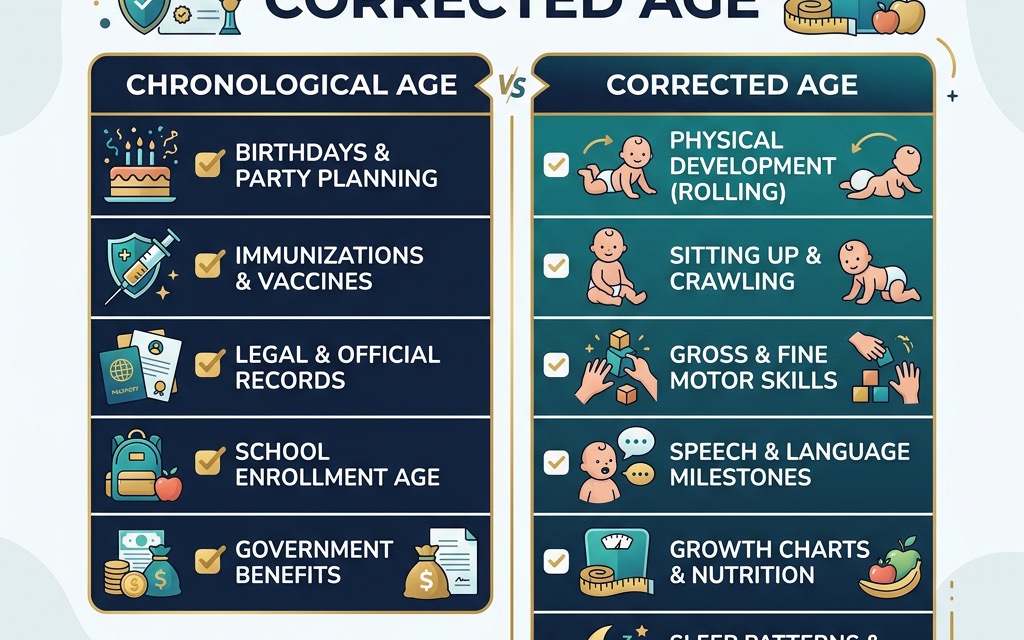
A comparison chart showing when to use Chronological Age (Birthdays, Vaccines, Legal Records) versus Corrected Age (Milestones, Growth, Therapy).

Parents often hear both terms in neonatal follow-up visits, therapy assessments, and pediatric appointments. The difference is simple but important.

Chronological age is the baby's actual age from birth. Corrected age is the developmental age after adjusting for prematurity. One is used for official records. The other is used for fair developmental comparison.

SituationUse Chronological AgeUse Corrected Age
Birthday and legal documentsYesNo
Developmental milestonesNoYes
School enrollment ageYesNo
Early therapy and follow-up reviewSometimesUsually yes

This distinction helps avoid unnecessary worry. A premature baby may look delayed by chronological age while actually progressing appropriately by corrected age.

Why Corrected Age Matters for Milestones

Corrected age is most useful when tracking milestones such as head control, rolling, sitting, crawling, babbling, and early social interaction. These early milestones are strongly influenced by how much time the baby had to grow before birth.

A baby born several weeks early may hit milestones later by the calendar, but on time when corrected age is used. That is why corrected age is so helpful in the first months and years.

Milestone ReviewWhy Corrected Age Helps
Motor milestonesPremature babies may reach rolling, sitting, and crawling later by birth date
Feeding and growth reviewsAdjustment helps frame progress more accurately
Speech and social milestonesPrematurity can shift timing in the early months
Therapy assessmentsCorrected age often gives a more realistic developmental baseline

Practical takeaway: Corrected age can reduce confusion, but it should never be used to dismiss a genuine concern. If something feels off, bring it up with your pediatrician or developmental specialist.

When Do You Stop Using Corrected Age?

Many clinicians use corrected age until about 2 years old for general developmental tracking. For babies born very early, some teams may continue considering corrected age until around 3 years old depending on the situation.

The reason is simple: as children grow, the developmental gap caused by prematurity often narrows. Over time, chronological age becomes more useful again as the primary reference point.

Age RangeHow Corrected Age Is Commonly Used
Birth to 12 monthsVery important for milestone interpretation
12 to 24 monthsCommonly still used in follow-up and developmental review
24 to 36 monthsMay still matter for very preterm children
Beyond 3 yearsUsually less central unless advised by specialists

Your child's care team may give more specific guidance based on gestational age at birth, NICU history, growth, and developmental progress.

Common Corrected Age Mistakes Parents Make

The most common mistake is comparing a premature baby to full-term milestone charts using chronological age only. That can make normal progress look delayed.

Another common mistake is subtracting months loosely instead of using the actual number of weeks early. A baby born 7 weeks early should be adjusted by 7 weeks, not simply rounded up or down to a full month estimate.

MistakeBetter Approach
Using only birth-date age for milestonesUse corrected age for developmental comparisons
Guessing how early the baby wasCount the actual weeks between birth and due date
Thinking corrected age changes the birthdayKeep birthday for records, corrected age for development
Ignoring concerns because of prematurityUse corrected age, but still discuss concerns with clinicians

If you want a broader framework for child health calculations, the Pediatric Medical Math Guide is the most relevant related guide on the site.

Frequently Asked Questions

How do you calculate corrected age for a premature baby?

Calculate the baby's chronological age from the birth date, then subtract how many weeks early the baby was born. For example, if the baby is 6 months old and was born 8 weeks early, the corrected age is about 4 months.

What is the difference between corrected age and chronological age?

Chronological age is the actual time since birth. Corrected age adjusts that number for prematurity so development can be compared more fairly to expected milestones.

Why do doctors use corrected age for preemies?

Doctors use corrected age because babies born early had less time to grow before birth. Without adjusting for prematurity, milestone tracking can make a baby look delayed even when development is appropriate for how early they were born.

Until what age do you use corrected age?

Many clinicians use corrected age until about 2 years old for milestone tracking. For very premature babies, some may continue considering corrected age up to around 3 years depending on the child's progress and follow-up plan.

Does corrected age apply to full-term babies?

No. Corrected age is mainly used for babies born before 37 weeks gestation. Full-term babies are typically tracked using chronological age alone.

If my baby was born 6 weeks early and is 5 months old, what is the corrected age?

Subtract the 6 weeks of prematurity from the 5-month chronological age. That gives a corrected age of about 3.5 months, which is the more useful comparison point for early developmental milestones.

Is corrected age used for school enrollment or birthdays?

No. School enrollment, birthdays, and legal records use the actual birth date and chronological age. Corrected age is mainly used for developmental and follow-up assessment.

Author Spotlight

The Calculory Team

Health Content and Research

We create medically informed calculators and practical educational content to help families understand pregnancy, child development, and health-related math.

Verified Expert Educator
corrected age premature babycorrected age calculatoradjusted age preemiehow to calculate corrected agepremature baby milestonescorrected age vs chronological agepreterm baby developmenthow many weeks early baby