Sustainability6 min readUpdated Apr 25, 2026

Repair vs Replace: The 2026 Decision Rule That Saves Money

The Calculory Team

Circular Economy and Consumer Decision Research

Stop guessing whether to repair or replace. Use the 2026 cost-per-year rule with operating costs, resale value, and embedded carbon to decide in under a minute.

Repair vs Replace: The 2026 Decision Rule That Saves Money

Key Takeaways

  • The decision rule is simple: lower cost per year of use wins, every time.
  • Repair almost always wins when the quote is under 50 percent of a comparable new product and adds at least 3 years of life.
  • Resale value of the current item must be netted against any new purchase or the comparison is dishonest.
  • Operating cost gaps matter when efficiency improvements exceed 10 percent, common with appliances and EVs.
  • Manufacturing emissions on a new product often dwarf the operational savings of a more efficient replacement in the first 3 to 5 years.
  • When the gap between options is under 5 percent, choose on warranty and reliability, not pure dollars.

Quick Comparison

1

Why the Repair vs Replace Decision Matters in 2026

In 2026, repair-or-replace stopped being a guilt question and became a money question. Right-to-repair laws in the EU, UK, and 31 US states have pulled repair pricing into the open, manufacturers now publish parts and service manuals, and independent repair shops are competing on transparent quotes.

That is good news for buyers, but it raises a new problem: when you can actually get a quote, you have to decide. And the wrong decision typically costs $200 to $2,000 over a 5-year horizon depending on the asset class.

EraRepair Decision FrictionTypical Outcome
Pre-2020Hard to get quotes, parts unavailableDefault to replace
2026Quotes available, parts in stockDecision depends on math

Use the Repair vs Replace Calculator to settle any specific decision in under a minute.
2

The Decision Rule and Formula Set

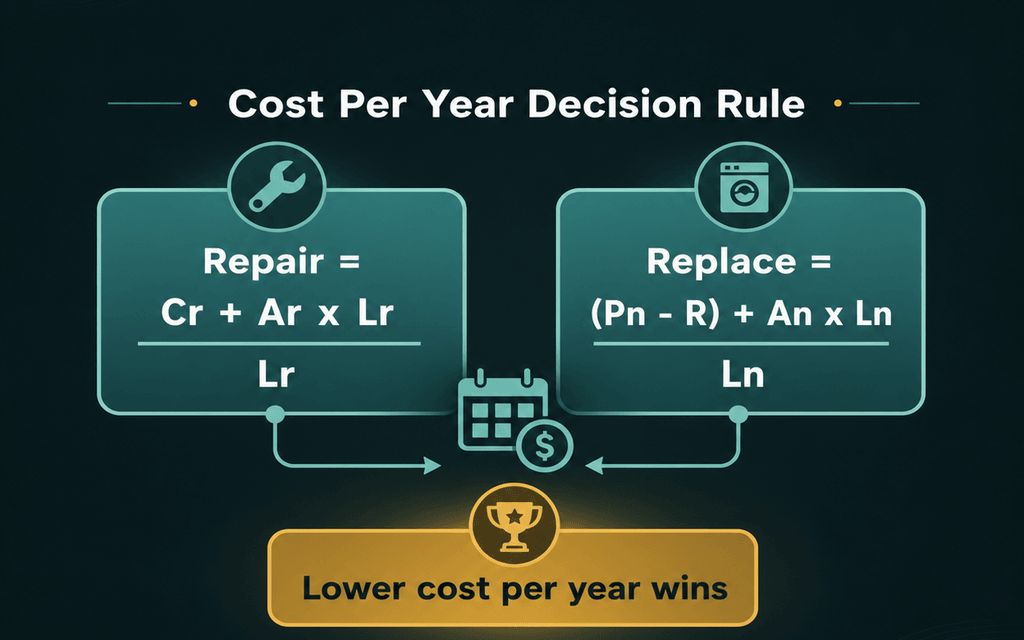
Infographic comparing the repair cost per year formula against the replace cost per year formula, ending with the rule that the lower annual cost wins.

The rule is one inequality. Whichever option costs less per year of use is the better economic choice.

Variables

  • Cr = Repair cost (one-time)
  • Lr = Extra years of life from repair
  • Pn = New product price
  • Ln = Lifespan of the new product
  • R = Resale value of the current item if you replace
  • Ar = Annual operating cost of the current item
  • An = Annual operating cost of the new item

Step 1: Repair Cost Per Year

Repair Cost per Year = (Cr + Ar x Lr) / Lr

Step 2: Replace Cost Per Year

Replace Cost per Year = ((Pn - R) + An x Ln) / Ln

Step 3: Apply the Decision Rule

If Repair Cost per Year < Replace Cost per Year, recommend REPAIR. Otherwise, recommend REPLACE.

OutputMeaningAction
Repair cheaper by 30%+Strong economic and circular winFix it
Repair cheaper by 5 to 30%Marginal but still winsFix it, factor in convenience
Replace cheaper by 5 to 30%New product modestly cheaper per yearReplace if warranty matters
Replace cheaper by 30%+Replacement clearly winsBuy new

For larger purchase decisions like a new car, appliance, or solar system, layer in the Circular TCO Calculator for full ownership comparisons.

3

Sample Use Case: Washing Machine Repair Quote

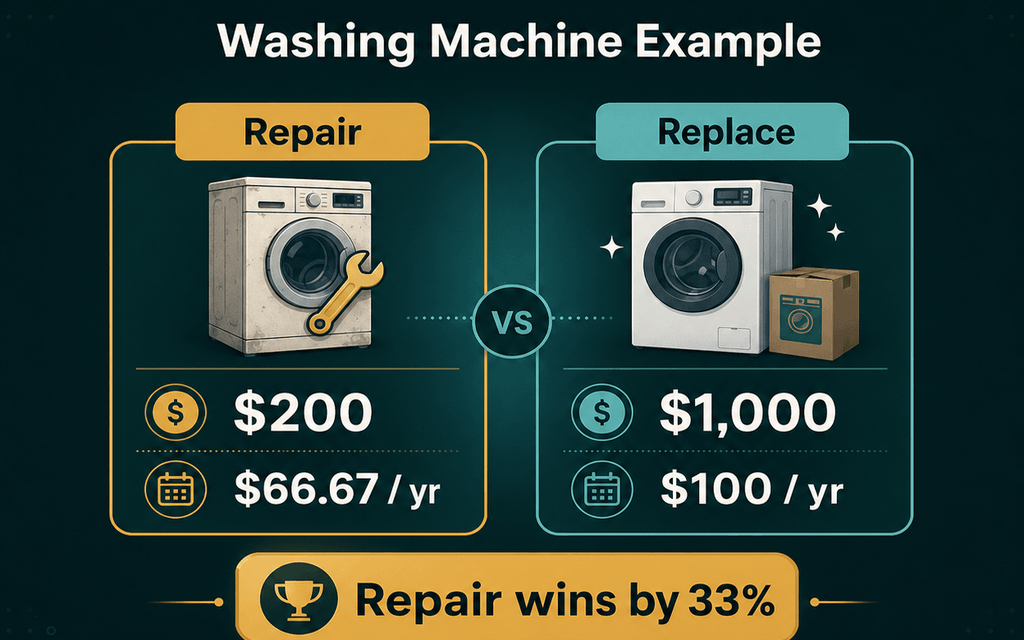
Side-by-side washing machine repair versus replace example showing a $200 repair at $66.67 per year compared with a $1,000 replacement at $100 per year, with repair winning by 33 percent.

An 8-year-old washing machine fails. The repair tech quotes $200 for a new pump and belt with an expected 3 more years of life. A new mid-range machine is $1,000 with a 10-year expected life. The old machine has zero resale value as-is. Operating costs are similar.

Scenario assumptions:

  • Repair cost: $200, extends life by 3 years
  • New machine: $1,000, 10-year lifespan
  • Resale of current machine: $0
  • Operating cost gap: roughly the same
OptionTotal Cost Over PeriodCost Per YearVerdict
Repair$200 over 3 years$66.67/yrREPAIR
Replace$1,000 over 10 years$100.00/yr33% more expensive per year

Repair wins by 33 percent on cost per year, and you avoid roughly 80 kg of embedded manufacturing CO2 by skipping the new machine. This is the kind of decision the rule was built for.

4

The Hidden Cost That Tilts Almost Every Decision Toward Repair

Manufacturing a new appliance or electronic device carries large embedded carbon emissions, sometimes called Scope 3 or upstream emissions. These rarely show up on a price tag but are real environmental costs.

A new washing machine carries roughly 80 to 120 kg of embedded CO2. A new laptop runs 200 to 400 kg. A new smartphone is 60 to 80 kg. Operational efficiency gains from a newer model rarely offset that in the first 3 to 5 years.

ProductEmbedded CO2 (Manufacturing)Years to Offset via Efficiency
Washing machine80 to 120 kg5 to 10 years (only if efficiency gap is large)
Laptop200 to 400 kgAlmost never offset by efficiency alone
Smartphone60 to 80 kgRarely offset, repair is greener
Refrigerator300 to 500 kg3 to 7 years if old unit is pre-2010

This is why the Carbon Footprint Calculator consistently shows that extending product life is one of the highest-leverage actions an individual can take.

5

Common Repair Traps and How to Avoid Them

Not every repair is worth doing. The rule catches most cases, but a few common traps trick people into the wrong decision.

TrapWhy It MisleadsHow to Avoid
Sunk cost on past repairsPast spending is irrelevant to today's decisionOnly compare future cost per year
Multiple impending failuresFixing one part means another breaks soonAsk the tech what else is at risk
Discontinued partsFuture repairs become impossibleCheck parts availability before deciding
Safety riskOld gas appliances or wiringReplace any safety-critical item without question
Emotional attachment to brandLoyalty to a make that no longer holds valueRun the math on cost per year, ignore branding

A $300 motherboard replacement on a 6-year-old laptop is usually a bad call because the next failure is rarely far behind. The same $300 spent on a battery and SSD upgrade on a 4-year-old laptop is often excellent.

6

When Replace Genuinely Wins

The rule works both ways. Replace makes clear economic sense in several common scenarios that consumers tend to overcomplicate.

  • Repair quote exceeds 50 percent of a comparable new product, with no warranty on the repair
  • Item is past its expected useful life and the failure is structural (motor, drum, frame)
  • New version is dramatically more efficient (a pre-2010 fridge replaced in 2026 saves 40 percent on electricity)
  • The current item creates a safety risk
  • Parts are discontinued and future repairs are impossible
ItemStrong Replace SignalApproximate Threshold
RefrigeratorCompressor failure on a 12+ year unitRepair > $400 on a $1,200 new unit
LaptopLogic board failure on a 6+ year unitRepair > $300 on a $1,000 new unit
Washing machineDrum bearing on a 10+ year unitRepair > $400 on a $1,000 new unit
PhoneLiquid damage on a 4+ year unitRepair > 50% of a refurb of same model

For major appliance replacements, pair this with the Solar Payback Calculator if your household is also considering reducing total energy demand.

7

pSEO Modifiers for Scaling 100+ Repair Decision Pages

Repair decisions are highly searchable because they happen at the moment of need. People type "is it worth repairing my washer" the same week they get a quote. A scaled cluster captures this intent.

Modifier AxisValuesTemplate Pattern
By ItemPhone, Laptop, Washing Machine, Fridge, Bike, EV, FurnitureShould I Repair or Replace My [Item]
By FailureBattery, Screen, Drum, Compressor, Motor[Item] [Failure] Repair vs Replace
By BrandApple, Samsung, LG, Whirlpool, BoschIs It Worth Repairing a [Brand] [Item]
By Age5 years, 8 years, 10 yearsRepair or Replace a [Age]-Year-Old [Item]

This matrix easily produces 200+ targeted pages without thin content because each page can pull in real repair quote ranges and lifespan benchmarks for that specific combination.

8

Conclusion: Make the Decision in Under a Minute

The repair vs replace question used to feel emotional. In 2026, with transparent repair pricing and a clear cost-per-year rule, it can be a one-minute decision.

When the math is close, default to repair: you save the embedded manufacturing CO2, you keep money in the local repair economy, and you usually avoid the warranty and onboarding hassle of a new product. When the math is clearly against repair, the calculator says so, and you replace with confidence.

Frequently Asked Questions

What is the repair vs replace decision rule?

The rule is to compare cost per year of use. Repair Cost per Year = (Repair Cost + Annual Operating x Extension Years) / Extension Years. Replace Cost per Year = ((New Cost - Resale Value) + Annual Operating x New Lifespan) / New Lifespan. Whichever is lower wins.

Should I repair if the quote is high?

Use the 50 percent rule as a starting point. If the repair quote is over half the price of a comparable new product, replacement usually wins on cost per year unless the repair extends life by at least 5 years. Always run the calculator with your specific numbers before deciding.

Does the rule include environmental cost?

The base rule is purely economic. The hidden bonus for repair is that you avoid the embedded carbon of manufacturing a new product, which can range from 60 kg for a phone to 500 kg for a fridge. Most efficient new products do not offset that within 3 to 5 years.

How do I value my current item if I replace it?

Check resale platforms like eBay, Facebook Marketplace, or appliance trade-in programs for the same model in similar condition. Even broken items have value: a non-working laptop fetches $50 to $150 for parts, a non-working dishwasher might bring $30 to $80 for scrap metal.

When should I replace even if repair is cheaper per year?

Three scenarios override the rule. First, safety risk on gas, electrical, or pressure systems. Second, the new product is dramatically more efficient (10 percent or more annual savings on a frequently-used appliance). Third, parts are discontinued and future repairs become impossible.

How much do typical repairs cost in 2026?

Smartphone screen $80 to $250, laptop battery $80 to $200, washing machine pump or belt $150 to $300, refrigerator thermostat $150 to $250, dishwasher pump $200 to $400, EV 12V battery $150 to $300. Always get a written quote before deciding.

Are repairs always greener than replacing?

Almost always, but not universally. Replacing a pre-2010 refrigerator with a modern ENERGY STAR unit can offset embedded manufacturing carbon within 3 to 5 years because the efficiency gap is so large. For most products built after 2015, repair stays greener for the life of the item.

Author Spotlight

The Calculory Team

Circular Economy and Consumer Decision Research

We turn repair-or-replace decisions into clear math so households and small businesses can stop overpaying and stop tossing perfectly fixable goods.

Verified Expert Educator
repair vs replacecost per year decision rulecircular economy decisionsright to repair 2026appliance repair cost calculatorlaptop repair vs replacephone repair vs newsustainable purchase decisionsembedded carbonrepair payback2026