Sustainability5 min readUpdated Apr 25, 2026

Solar Payback Blueprint 2026: True ROI Math for Homeowners

The Calculory Team

Renewable Energy and Residential ROI Research

Stop using flat-rate solar payback math. The 2026 blueprint includes rate inflation, panel degradation, the 30 percent federal credit, and exact months to break-even.

Solar Payback Blueprint 2026: True ROI Math for Homeowners

Key Takeaways

  • Most US residential solar installs in 2026 pay back in 6 to 10 years and run essentially free for another 15 to 20.
  • The 30 percent federal Residential Clean Energy Credit applies through 2032, then steps down to 26 percent in 2033 and 22 percent in 2034.
  • Year-by-year modeling matters: electricity rate inflation of 3 to 4 percent and panel degradation of 0.5 percent per year change the answer materially.
  • Net metering policy is now the single biggest variable across US states, with full retail crediting cutting payback by 1 to 3 years.
  • Lifetime ROI on a typical 8 kW residential install lands between 200 and 500 percent over 25 years.
  • If your annual electricity bill is below $1,800, the math gets tighter and a smaller system or longer hold becomes essential.

Quick Comparison

1

Why Solar Payback Math Got Sharper in 2026

Solar in 2026 is a different decision than it was three years ago. Installed costs have stabilized at $2.80 to $4.00 per watt nationally. The federal Residential Clean Energy Credit is locked at 30 percent through 2032, with no income cap and no maximum credit amount. Most states have either net metering (full retail credit) or net billing (wholesale credit), and the difference is huge for payback math.

The shift means buyers now get accurate quotes within a $2,000 range, but they still see wildly different payback claims. The reason: most online estimators ignore three real variables.

Variable Often SkippedAnnual EffectWhy It Matters Over 25 Years
Electricity rate inflation+3 to 4 percent per yearYear 25 savings are 2.5x year 1 savings
Panel degradation-0.5 percent per yearYear 25 production is 87 percent of year 1
Maintenance and inverter$100 to $300 per yearInverter replacement at year 12 to 15

Use the Solar Payback Calculator to model all three and see your exact payback in months.
2

The Payback Formula and Cost Build-Up

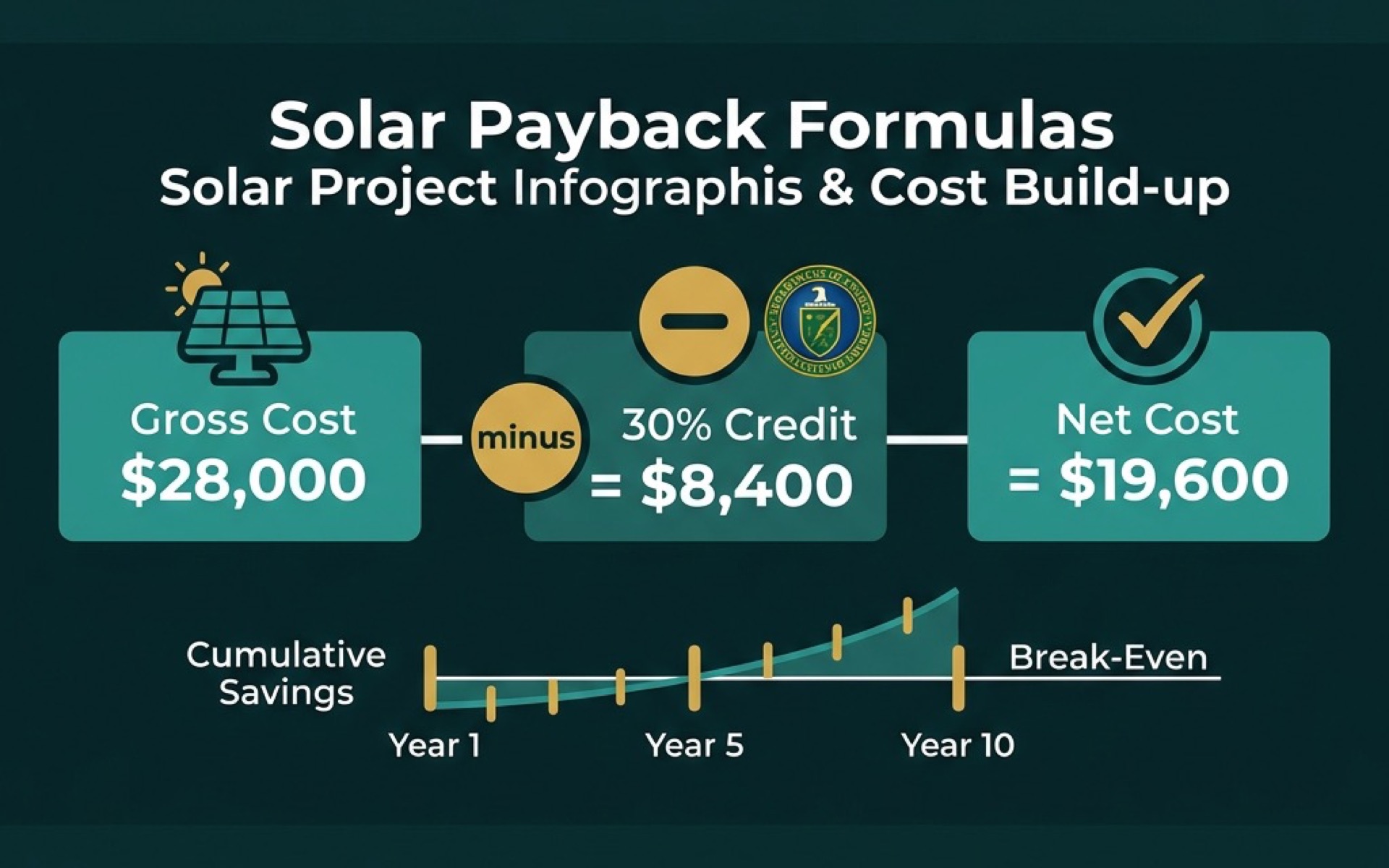
Solar payback cost build-up infographic showing gross system cost of $28,000 minus 30 percent federal tax credit of $8,400 equals net cost of $19,600, with cumulative savings curve rising year by year and crossing the break-even threshold by year 10

Solar payback math has two parts: the upfront cost build-up and the year-by-year savings model.

Variables

  • kW = System size in kilowatts
  • Pw = Cost per watt installed
  • Cfed = Federal tax credit (30 percent in 2026)
  • Rstate = State or utility rebate
  • B = Current annual electricity bill
  • O = Bill offset percentage
  • i = Annual electricity rate inflation (3 to 4 percent typical)
  • d = Annual panel degradation (0.5 percent typical)

Step 1: Net System Cost

Net Cost = (kW x Pw x 1000) - (kW x Pw x 1000 x Cfed) - Rstate

Step 2: Year N Savings

Year N Savings = (B x O) x (1 + i)^(N-1) x (1 - d)^(N-1)

Step 3: Payback Year

Payback Year = first N where Sum(Year 1 to Year N savings) >= Net Cost

OutputMeaningDecision Use
Net costWhat solar actually costs after incentivesTrue investment figure
Year 1 savingsFirst-year reduction in electricity billsSanity check on system size
Payback yearWhen cumulative savings cover net costHeadline buying decision
25-year ROITotal savings vs net cost over panel warrantyLong-term return comparison

Validate the broader investment context with ROI Calculator and Compound Interest Calculator for an alternative-investment comparison.

3

Sample Use Case: 8 kW System in California vs Texas

Same 8 kW system. Same install cost. Same federal credit. Two states. Two very different payback periods.

Scenario assumptions for both:

  • System size: 8 kW
  • Install cost: $3.50 per watt = $28,000 gross
  • Federal credit: 30 percent = $8,400
  • State rebate: $0 (for fairness)
  • Net system cost: $19,600
  • Annual maintenance: $150
VariableCaliforniaTexas
Average electricity rate$0.30/kWh$0.14/kWh
Annual electricity bill$3,600$1,680
Year 1 gross savings (90% offset)$3,240$1,512
Year 1 net savings$3,090$1,362
Payback period~6.0 years~12.5 years
25-year net savings~$108,000~$48,000
25-year ROI~451%~145%

The lesson: solar economics are 70 percent local. The same hardware, the same incentives, and the same installer can produce wildly different outcomes based on what the grid charges in your area.

4

Year-by-Year Modeling vs Flat-Rate Math

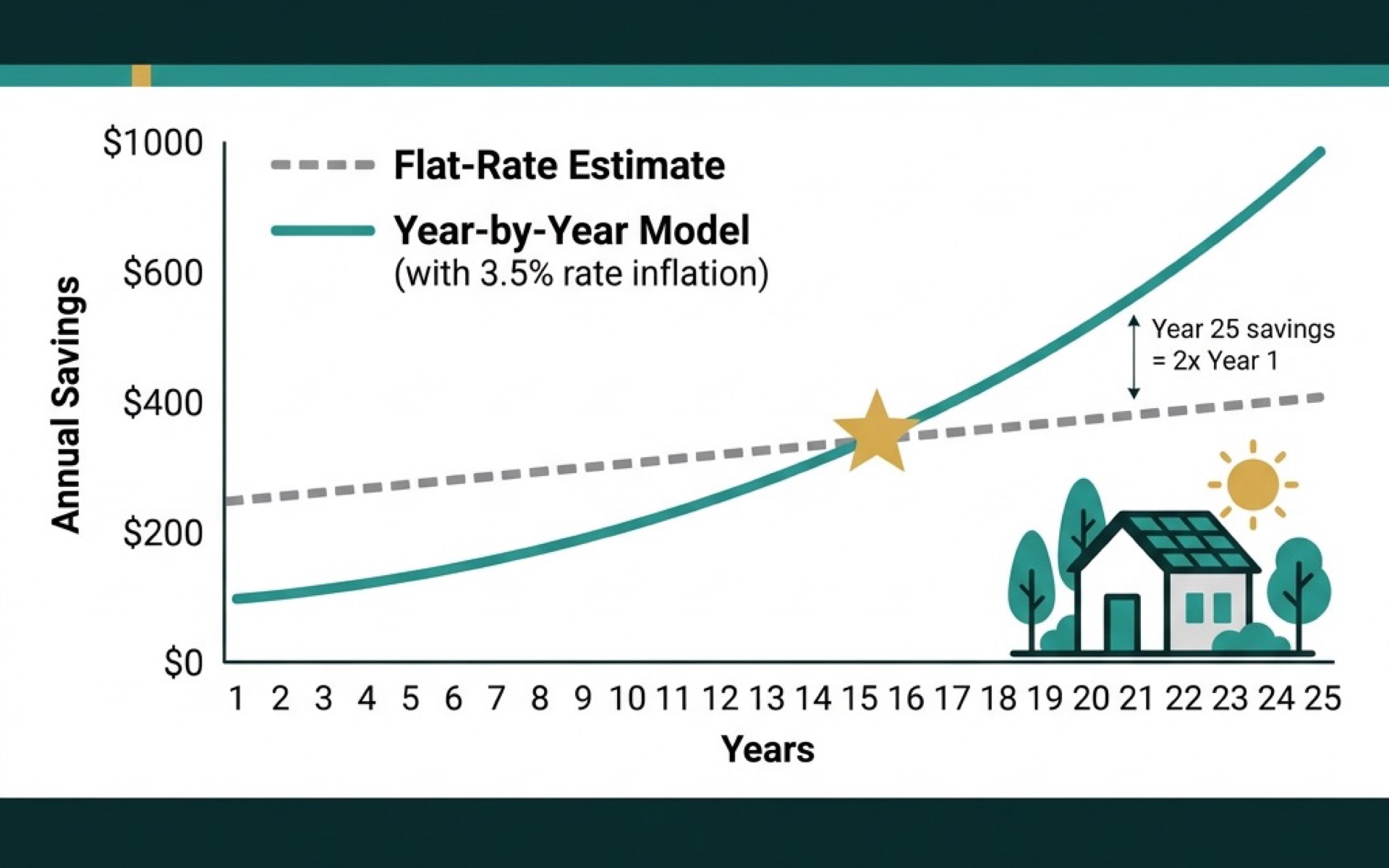
Chart comparing flat-rate estimate as a straight dashed gray line against year-by-year model as a rising teal curve with 3.5 percent rate inflation, showing the curves diverging significantly by year 15 with a gold star and annotation that year 25 savings equal 2 times year 1 savings

Most quick estimators divide net cost by year 1 savings and call it the payback period. This is wrong by 1 to 3 years in either direction.

The right approach is year-by-year accumulation. Electricity rates have inflated 3 to 4 percent per year on average across US utilities since 2010. Solar panels degrade about 0.5 percent per year. Both effects compound, and the inflation effect dominates.

YearElectricity Bill (with 3.5% inflation)Solar Production (with 0.5% degradation)Net Savings
Year 1$2,400100% of design$2,160
Year 5$2,75298% of design$2,427
Year 10$3,26795.5% of design$2,808
Year 15$3,87993% of design$3,247
Year 25$5,47188.5% of design$4,358

The upshot: by year 25, your annual savings are double what they were in year 1. Flat-rate payback math undersells solar by ignoring this entirely. Real payback is usually 1 to 2 years sooner than the lazy estimate suggests.

5

Net Metering Policy and Why It Changes Everything

Net metering is the policy that determines what you get paid for excess solar production sent back to the grid. There are three flavors in 2026.

PolicyWhat You GetEffect on Payback
Full net metering1:1 retail credit on excess productionBest case, payback 5 to 8 years
Net billing (NEM 3.0 in CA)Wholesale or avoided-cost rate, often $0.05 to $0.08/kWhAdds 1 to 3 years to payback
No net meteringExcess production lostAdds 3 to 5 years, requires battery

In states with net billing or no net metering, adding battery storage becomes essential to capture value from excess production. This raises system cost by $8,000 to $15,000 but recovers $400 to $1,200 per year in additional savings. The Circular TCO Calculator can model the battery investment as a separate Linear vs Circular comparison if you want to evaluate it independently.

6

Common Solar Mistakes That Wreck Payback

Solar is a long-duration investment, and a few avoidable mistakes can extend payback by 3 to 5 years.

MistakeWhy It HurtsHow to Avoid
Oversizing the systemYou generate excess that gets credited at low ratesMatch production to 90 to 100% of usage
Financing through dealer at high rateLoan interest exceeds savings rateUse HELOC or solar-specific loan under 7%
Skipping the roof inspectionReroof at year 8 means uninstall and reinstallReplace roof before solar if it has under 15 years left
Cheap inverter, no monitoringFailures go undetected for monthsSpec a tier-one inverter with cellular monitoring
Ignoring net metering policyWrong system size for your stateCheck your utility's NEM rules first

A correctly-sized 8 kW system on a recently-replaced roof with a quality inverter and full net metering is the payback math everyone wants. Cut corners on any of those four and the math drifts.

7

pSEO Modifiers for Scaling 100+ Solar Pages

Solar search intent is highly local, highly specific, and highly time-sensitive (rebate windows, tax credit changes, utility rate hikes). A scaled cluster captures this without thin-content risk.

Modifier AxisValuesTemplate Pattern
By StateCalifornia, Texas, New York, Florida, Massachusetts, Arizona, North CarolinaSolar Payback in [State] 2026
By System Size5 kW, 8 kW, 10 kW, 12 kW, 15 kW[Size] Solar System Payback Calculator
By Use CaseHome, RV, Cabin, Small Business, FarmSolar Payback for [Use Case]
By Incentive30% Federal, State Rebate, SREC Income, Net MeteringHow [Incentive] Affects Solar Payback

Pair state pages with utility-specific net metering details and you have a high-intent cluster that captures buyers in active research mode.

8

Conclusion: Solar Is a Math Decision, Not a Belief

Solar in 2026 stops being a values question and becomes a math question. The 30 percent federal credit, dropping install costs, and rising electricity rates have collapsed payback to under 10 years for most US homeowners with a $1,800-plus annual bill.

The winning approach is to model your specific state, your specific bill, and your specific net metering policy. The headline number you actually need is months to break-even, and a year-by-year model with inflation and degradation is the only honest way to get there.

Frequently Asked Questions

How is solar payback calculated in 2026?

Net system cost is gross install minus 30 percent federal tax credit minus any state rebate. Year-by-year savings start at your current annual bill multiplied by the offset percent, grow with electricity rate inflation, and shrink slightly with panel degradation. Payback year is the first year cumulative savings exceed net cost.

Does the federal solar tax credit really cover 30 percent?

Yes. The Residential Clean Energy Credit (Section 25D) covers 30 percent of total system cost through 2032, then 26 percent in 2033 and 22 percent in 2034. There is no income cap and no maximum credit amount. You must owe federal income tax in the year you claim it.

What is a typical residential solar payback period?

In 2026, most US installs pay back in 6 to 10 years. High-rate states like California, Massachusetts, Hawaii, and New York often see 5 to 7 years. Low-rate states like Texas, Louisiana, and Washington can stretch to 11 to 15 years.

Should I include electricity rate inflation in payback math?

Yes. US residential rates have inflated 3 to 4 percent per year on average since 2010, and the trend is expected to continue. Ignoring inflation undersells solar by 1 to 2 years on payback. Use 3.5 percent as a planning default unless you have local data.

How long do solar panels actually last?

Most modern panels carry a 25-year production warranty guaranteeing at least 80 to 85 percent of original output by year 25. Real-world degradation is about 0.4 to 0.6 percent per year, so panels typically still produce 87 to 90 percent of original output at year 25 and continue working well into year 30 to 40.

Is solar still worth it without state rebates?

In most US states, yes. The 30 percent federal credit alone pulls payback under 10 years for any household with an annual bill above $1,800. Below that threshold, the math gets tighter and a smaller system, longer hold, or alternative investment becomes worth comparing.

What happens if I sell my house before payback?

Solar typically adds 3 to 4 percent to home value per NREL studies, often recovering most or all unrecovered cost. Your appraiser should treat it as a value-add, not a personal-property exclusion. The calculator does not include resale uplift, so payback is conservative for owners planning to move within the payback window.

Author Spotlight

The Calculory Team

Renewable Energy and Residential ROI Research

We translate complex residential energy decisions into clear payback math so homeowners can decide on solar without sales pressure.

Verified Expert Educator
solar payback calculatorresidential solar roi30 percent federal solar tax creditsolar payback period 2026net metering policysolar panel degradationelectricity rate inflationhome solar investmentsolar break-evensustainable home upgrades2026