Regional12 min readUpdated Mar 28, 2026

US Tax vs India Tax: Income Tax Slabs, GST, EPF, and Take-Home Pay Compared

The Calculory Team

Tax Comparison Research

Compare US and Indian tax systems in detail. See how federal income tax vs India's new tax regime slabs, GST, PF deductions, and in-hand salary compare for working professionals in both countries.

US Tax vs India Tax: Income Tax Slabs, GST, EPF, and Take-Home Pay Compared

Key Takeaways

  • India's new tax regime (2025-26) has zero tax on income up to INR 12 lakh after the rebate, while the US charges 10% from $11,926 and has no equivalent income threshold rebate.
  • India's peak income tax rate of 30% applies on income above INR 15 lakh (approximately $17,500), while the US top federal rate of 37% applies only above $626,350.
  • India's GST is a multi-rate system with 0%, 5%, 12%, 18%, and 28% slabs depending on the product category, while the US has no federal sales tax and state rates range from 0% to 11%.
  • Indian employees contribute 12% of basic salary to the Employee Provident Fund (EPF), matched by employers. This mandatory retirement savings reduces in-hand pay but builds a long-term corpus.
  • The US has no universal public health insurance for working-age adults, while India's government hospitals provide free or heavily subsidised care, though quality and accessibility vary significantly.
  • On a gross salary of INR 15 lakh (approximately $17,500), an Indian professional takes home approximately INR 10.8 lakh after EPF and new-regime tax. The purchasing power gap is large, but India's cost of living is substantially lower.

How US and Indian Tax Systems Differ: A Quick Overview

Comparing the US and Indian tax systems requires understanding the very different economic contexts in which they operate. India has the world's fifth-largest economy by GDP but a per-capita income that is a fraction of the US level. The tax systems reflect these structural differences, with India relying more heavily on indirect taxes and compulsory savings mechanisms. Both countries use progressive income tax, but the structures are very different. The US federal system has seven brackets with rates from 10% to 37%, while India recently simplified its structure through a new tax regime introduced in FY 2023-24. Under India's new regime (now the default), there are six slabs from 0% to 30%, but crucially, a full rebate under Section 87A exempts income up to INR 12 lakh from any tax. India also operates an old tax regime with higher rates but more deductions (80C, 80D, HRA, LTA, etc.). Workers can choose between the two regimes annually, making the comparison more complex than a simple rate table. On consumption taxes, India uses a Goods and Services Tax (GST) with multiple rates (0%, 5%, 12%, 18%, 28%), unlike Australia's clean 10% single rate or the US's state-by-state patchwork system. The highest 28% slab applies to luxury and demerit goods. Retirement savings are handled through the Employee Provident Fund (EPF), a mandatory scheme where both employees and employers contribute 12% of basic salary, with the employee contribution reducing take-home pay. The US relies on voluntary 401(k) plans plus Social Security. Health insurance is another critical difference. India has a large public health infrastructure that is free or subsidised for many residents, though quality varies dramatically by location and institution. The US private health insurance system involves significant out-of-pocket costs even for insured workers. This guide compares both systems at realistic salary levels for Indian and US professionals.
Income Tax: US Federal Brackets vs India's New Tax Regime

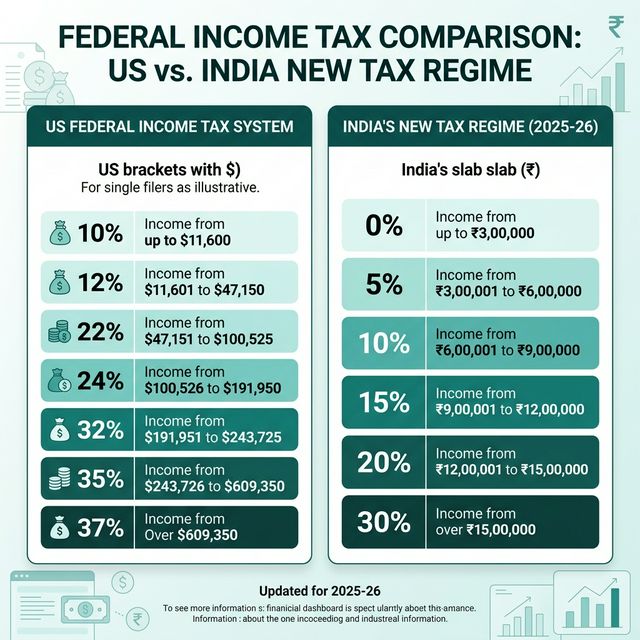
Side-by-side infographic comparing US federal income tax brackets and India's new tax regime slabs for 2025-26

Both countries tax income progressively, but the thresholds and the tax-free income levels differ significantly. US Federal Income Tax Brackets (2025, Single Filer): - 10% on the first $11,925 - 12% on $11,926 to $48,475 - 22% on $48,476 to $103,350 - 24% on $103,351 to $197,300 - 32% on $197,301 to $250,525 - 35% on $250,526 to $626,350 - 37% on income above $626,350 The US standard deduction for single filers is $15,200 in 2025. India's New Tax Regime (FY 2025-26, i.e. Assessment Year 2026-27): - 0% on income up to INR 4 lakh - 5% on INR 4,00,001 to INR 8 lakh - 10% on INR 8,00,001 to INR 12 lakh - 15% on INR 12,00,001 to INR 16 lakh - 20% on INR 16,00,001 to INR 20 lakh - 25% on INR 20,00,001 to INR 24 lakh - 30% on income above INR 24 lakh Standard deduction under new regime: INR 75,000. Section 87A Rebate: Full tax rebate for income up to INR 12 lakh (effective zero tax below this threshold). 4% health and education cess applies on all income tax. Key comparison: India's top rate of 30% (plus 4% cess = 31.2%) is significantly lower than the US top federal rate of 37%. More importantly, India's top rate kicks in at INR 24 lakh, which at current exchange rates (approximately INR 83 per USD) is only about $28,900. By contrast, the US 37% bracket begins at $626,350. This means high-income earners in India face a much lower absolute tax bill, but are also earning in a much lower absolute currency. For Indian professionals in the INR 10 to 20 lakh range (approximately $12,000 to $24,000), the new tax regime offers very competitive rates, especially with the zero-tax threshold up to INR 12 lakh. A US worker on an equivalent $12,000 salary would pay approximately $672 in federal income tax, while the Indian worker pays zero. India also retains an old tax regime with higher rates but allowing deductions for EPF, insurance premiums (Section 80C up to INR 1.5 lakh), health insurance (80D), HRA, and LTA. For those with significant EPF, insurance, and housing allowance, the old regime can result in lower net tax. Workers should calculate both before choosing.

State Income Tax: US States vs Indian States

The federal structure of both countries introduces regional layers in taxation, but they work very differently. In the US, 41 states levy their own income tax on top of federal rates. This creates massive variation in effective tax rates based purely on where a worker lives: - No state tax: Texas, Florida, Nevada, Wyoming, South Dakota, Alaska, Washington, Tennessee - Low-tax states: Arizona (2.5% flat), Colorado (4.4% flat) - Mid-tax states: Virginia (2 to 5.75%), Maryland (2 to 5.75%) - High-tax states: California (1 to 13.3%), New York (4 to 10.9%), New Jersey (1.4 to 10.75%) For a US worker earning $100,000 in California vs Texas, the state tax difference alone is approximately $8,000 to $10,000 per year. High earners in California face combined federal plus state marginal rates exceeding 50%. In India, state governments do not levy income tax. Income tax is a central subject under the Indian Constitution, administered exclusively by the central government through the Income Tax Department. This means every Indian worker in Mumbai, Bengaluru, Chennai, or Delhi faces exactly the same income tax rates. India does, however, have Professional Tax levied by state governments, but this is capped at a maximum of INR 2,500 per year across all states. This is negligible compared to US state income taxes. Property taxes in India are also levied at the municipal level and are generally very low in absolute terms compared to US property taxes, which average 1 to 1.5% of property value annually. For Indian professionals, the uniformity of the income tax system is a significant structural advantage. There is no reason to relocate from Mumbai to Hyderabad purely for income tax savings, unlike the strong financial incentive for US high earners to move from California to Texas.

GST in India vs Sales Tax in the US

Both countries tax consumption, but the mechanisms and rate structures are very different. India's Goods and Services Tax (GST) was introduced in July 2017 and unified a complex web of central and state indirect taxes into a single, nationwide system. GST has multiple rate slabs: - 0% (Nil): Essential food items (rice, wheat, milk, vegetables, fruits), healthcare services, education - 5%: Basic food items (packaged food, cooking oil), basic consumer goods, economy travel - 12%: Processed food, business-class air travel, smartphones below a certain price - 18%: Most electronics, FMCG goods, restaurant services (with input tax credit), IT services - 28%: Luxury goods, automobiles, tobacco, aerated drinks, casinos GST also applies to services, making India's system more comprehensive than many countries. Input Tax Credit allows businesses to claim back GST paid on inputs, reducing cascading tax effects. US Sales Tax: - No federal sales tax - 45 states and DC charge state sales tax - Combined state plus local rates range from 0% (Oregon, Montana, Delaware, New Hampshire) to over 11% (Tennessee, Louisiana) - Applies primarily to tangible goods; services are often exempt - Tax is added at checkout and not included in listed prices - Exemptions: groceries (in many states), prescription drugs, clothing (in some states) For everyday consumer goods, an Indian buying a mobile phone pays 18% GST, while a US consumer in Texas pays 8.25% and in Oregon pays 0%. For clothing, an Indian pays 12% GST while many US states zero-rate clothing. For luxury spending, India's 28% GST on automobiles and premier goods is among the highest consumption tax rates in the world, significantly higher than US sales tax on equivalent goods. For software and IT services, India charges 18% GST on most B2B transactions. This is highly relevant for the tech industry that drives much of India's professional economy.

EPF vs 401(k) and Social Security: Retirement Savings Compared

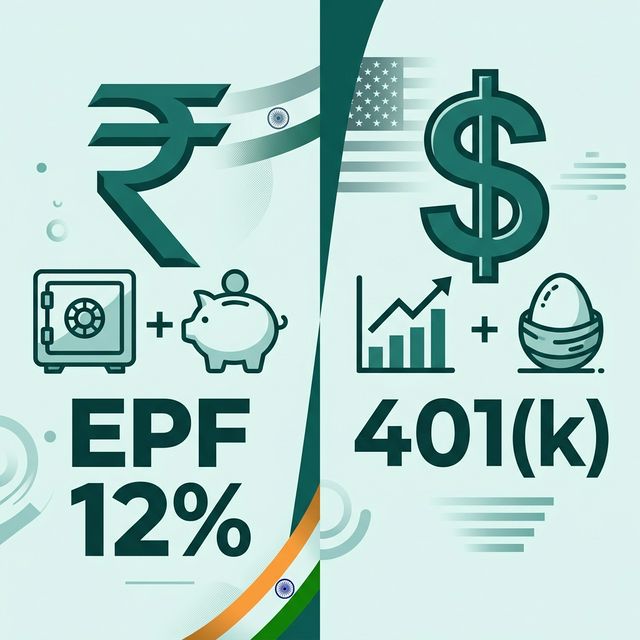
Comparison of India's EPF mandatory retirement savings and the US 401(k) and Social Security system

Retirement savings contributions are another important layer that affects take-home pay in India. India's Employee Provident Fund (EPF): - Employee contributes 12% of basic salary to EPF (mandatory for organisations with 20+ employees earning below INR 15,000 basic; voluntary above) - Employer also contributes 12% of basic salary: 3.67% to EPF, 8.33% to EPS (Employees' Pension Scheme) - Interest rate on EPF is declared annually by the government: 8.15% for FY 2023-24 - EPF balance is tax-free at maturity if withdrawn after 5 years of continuous service - Workers can also voluntarily contribute to the Voluntary Provident Fund (VPF) at higher rates - Gratuity: employers pay 15 days of salary per year of service after 5 years (up to INR 20 lakh tax-free) For a worker on INR 1 lakh per month basic, EPF deduction is INR 12,000 per month (employee share), reducing take-home by that amount but building a retirement corpus at attractive interest rates. US Retirement System: - Social Security: 6.2% on earnings up to $176,100, matched by employer - Medicare: 1.45% on all earnings, matched by employer - 401(k): Voluntary contributions up to $23,500 per year (2025). Many employers match 3 to 6% of salary. - Roth IRA: Additional voluntary savings of up to $7,000 per year (post-tax) Key differences: EPF is mandatory for most Indian employees and earns a government-guaranteed return around 8%. US 401(k) is voluntary, market-linked, and offers no guaranteed return. However, the US Social Security system provides a lifetime monthly benefit at retirement (up to approximately $4,018/month at age 67), while EPF is a lump-sum corpus. For Indian professionals moving to the US, one important consideration is that EPF contributions can continue to earn interest for three years after leaving India, but long-term non-resident EPF accounts stop earning interest after 36 months. Use the India In-Hand Salary Calculator to see exactly how EPF and income tax reduce your gross CTC to your monthly in-hand amount.

Healthcare: India's Public System vs US Private Insurance

Healthcare financing is a significant differentiator between the two countries and affects the true cost of working in each place. India's Healthcare System: - Government hospitals and district health centres provide free or heavily subsidised treatment - Ayushman Bharat (PM-JAY): government health insurance scheme covering hospitalisation costs up to INR 5 lakh per year for economically weaker sections - State government health schemes vary by state, with some (like Tamil Nadu and Kerala) offering more robust coverage - Professional employees in formal employment typically receive group medical insurance from employers, covering INR 3 to 10 lakh per year for the employee and family - Out-of-pocket medical costs are common: doctor consultations at private hospitals cost INR 500 to INR 2,000 per visit - Generic medication costs are extremely low due to price controls and the Jan Aushadhi scheme US Healthcare: - No universal coverage for working-age adults - Employees rely on employer-sponsored plans or ACA marketplace insurance - Average employee premium: approximately $7,400 per year for individual, $22,400 for family coverage - Deductibles of $1,000 to $5,000 before most coverage kicks in - Out-of-pocket maximums up to $9,450 per individual per year in-network The practical difference: an Indian professional earning INR 15 lakh per year spending INR 30,000 to 50,000 annually on private top-up health insurance gets comprehensive individual and family coverage. A US worker on an equivalent gross salary spending $7,400 per year in premiums plus potential deductibles faces a much higher healthcare cost burden relative to income. However, the quality of specialist care, medical technology, and treatment speeds at top Indian private hospitals has improved dramatically in major cities, with many seeking medical tourism from abroad for specific procedures. For rural and semi-urban workers, public facility quality remains inconsistent.

Take-Home Pay: INR 8 Lakh, 15 Lakh, and 25 Lakh Compared

The following examples compare in-hand pay at three salary levels using India's new tax regime for FY 2025-26. US comparisons show the equivalent USD amount at INR 83 per USD. All Indian figures assume basic salary is 50% of gross CTC (a common structuring convention). Salary: INR 8 Lakh per year (approximately $9,640 USD) India (New Tax Regime): - Gross: INR 8,00,000 - Standard deduction: INR 75,000 (taxable: INR 7,25,000) - Income tax: Section 87A rebate applies - effective zero tax - EPF (employee): 12% of basic (INR 4 lakh) = INR 48,000 per year - In-hand pay: approximately INR 7,52,000 per year (INR 62,667/month) - Take-home percentage: 94% of gross (excluding EPF, which is savings) US equivalent $9,640 (Texas): - Income tax: approximately $606 - FICA: $737 - Take-home: approximately $8,297 (86.1%) Salary: INR 15 Lakh per year (approximately $18,075 USD) India (New Tax Regime): - Gross: INR 15,00,000 - Standard deduction: INR 75,000 (taxable: INR 14,25,000) - Income tax: approximately INR 1,30,000 (no Section 87A rebate above 12L under new slabs) - 4% cess: INR 5,200 - Total tax: approximately INR 1,35,200 - EPF: 12% of basic (INR 7.5 lakh) = INR 90,000 per year - In-hand pay: approximately INR 12,74,800 per year (INR 1,06,233/month) - Take-home percentage: 85% of gross US equivalent $18,075 (Texas): - Federal income tax: approximately $1,256 - FICA: $1,383 - Take-home: approximately $15,436 (85.3%) US equivalent $18,075 (California): - Federal + state + FICA: approximately $4,200 - Take-home: approximately $13,875 (76.7%) Salary: INR 25 Lakh per year (approximately $30,120 USD) India (New Tax Regime): - Gross: INR 25,00,000 - Standard deduction: INR 75,000 (taxable: INR 24,25,000) - Income tax: approximately INR 3,35,000 - 4% cess: INR 13,400 - Total tax: approximately INR 3,48,400 - EPF: 12% of basic (INR 12.5 lakh) = INR 1,50,000 per year (subject to ceiling) - In-hand pay: approximately INR 20,01,600 per year (INR 1,66,800/month) - Take-home percentage: 80% of gross US equivalent $30,120 (Texas): - Federal income tax: approximately $2,684 - FICA: $2,304 - Take-home: approximately $25,132 (83.5%) Key pattern: At lower income levels, Indian workers benefit significantly from the zero-tax threshold under the new regime's Section 87A rebate. At higher income levels (25 lakh and above), US workers in low-tax states retain a higher percentage. However, the absolute purchasing power of INR in India vs USD in the US makes raw percentage comparisons somewhat misleading.

Which Country Has a Lower Tax Burden Overall?

Comparing the US and Indian tax burdens meaningfully requires acknowledging that the two countries are at fundamentally different stages of economic development, and that income levels, costs of living, and currency purchasing power are not directly comparable. India has a lower nominal income tax burden when: - Your income is below INR 12 lakh (approximately $14,500) under the new regime with 87A rebate - You are in the INR 12 to 25 lakh range and live in India, where absolute costs are much lower - You compare only income tax rates at the higher end (India tops out at 30% vs US at 37%) - You do not add the 12% EPF deduction to the comparison The US has a lower effective burden when: - You are a very high earner in absolute USD terms - You live in a zero-income-tax US state like Texas or Florida - You include the fact that Social Security provides a lifetime annuity at retirement, vs EPF which is a lump sum - You value the maturity and liquidity of US financial markets for wealth building For Indian professionals working in the US on H-1B or other work visas, the US system typically offers far higher absolute take-home salaries even after taxation, because US tech and finance salaries for Indian professionals are often 5 to 10 times their Indian equivalent in USD terms. For US professionals in India (expats), the comparison flips: local Indian salaries feel low in USD, but cost-of-living adjustments typically make senior expat packages tax-equalised with significant purchasing power. Use the India In-Hand Salary Calculator to estimate your exact in-hand pay from CTC, and compare with the US Salary Calculator and Take-Home Pay Calculator to understand your personal position in both systems.

Author Spotlight

The Calculory Team

Tax Comparison Research

We research and compare global tax systems so you can make informed decisions about your income, savings, and career moves across borders.

Verified Expert Educator
us-tax-vs-india-taxus-vs-india-tax-comparisonindia-vs-us-income-taxindia-new-tax-regimeepf-vs-401kindia-gst-vs-us-sales-taxin-hand-salary-indiaincome-tax-slabs-india-2025tax-comparisoninternational-tax