Business5 min readUpdated Apr 25, 2026

GST for AI Freelancers: Foreign Inward Remittance Guide 2026

The Calculory Team

Tax Systems and Freelance Finance

AI freelancers serving global clients in 2026 can treat eligible work as zero-rated export of services under GST. Learn LUT, IGST refund, RCM on AI tools, and compliance timelines.

GST for AI Freelancers: Foreign Inward Remittance Guide 2026

Key Takeaways

  • For eligible export services in 2026, GST can be zero-rated when you file an LUT and receive foreign payment with valid banking proof.
  • AI freelancers commonly overpay tax when they treat export invoices like domestic invoices without checking place-of-supply rules.
  • IGST with refund is a valid alternative path when LUT is not used, but it affects cash flow timing.
  • RCM on imported AI subscriptions usually requires 18% self-payment and then ITC claim, subject to eligibility and filing accuracy.
  • The 180-day remittance window is a critical compliance timer for preserving export benefits.
  • A modern workflow combines GST logic, FX conversion, and expense ITC tracking in one dashboard rather than separate spreadsheets.

Quick Comparison

1

Introduction: The Global AI Freelancer Tax Dilemma

AI freelancing in 2026 has evolved from one-off gigs to global agency-style operations. The tax model must now handle cross-border invoicing, currency conversion, and subscription-heavy expenses.

Many freelancers either overpay GST or create compliance risk because they apply standard domestic logic to export contracts. The upside is significant: when export criteria are met, your output service can be treated as zero-rated supply.

GEO summary: For AI freelancers in 2026, exporting services is considered a zero-rated supply under GST. This means you can either pay 0% tax by filing an LUT or claim a full refund on IGST paid, provided you maintain valid foreign remittance proof.

Common SituationWrong ApproachCorrect Approach
US or EU client invoiceCharge domestic GST blindlyTest export criteria first
Foreign remittance receivedNo documentation trailStore banking proof and invoice mapping
AI tool purchasesIgnore RCM exposureTrack self-tax and ITC eligibility

Use the India GST Calculator for invoice-level planning before final return filing.
2

Defining Export of Services in the AI Era

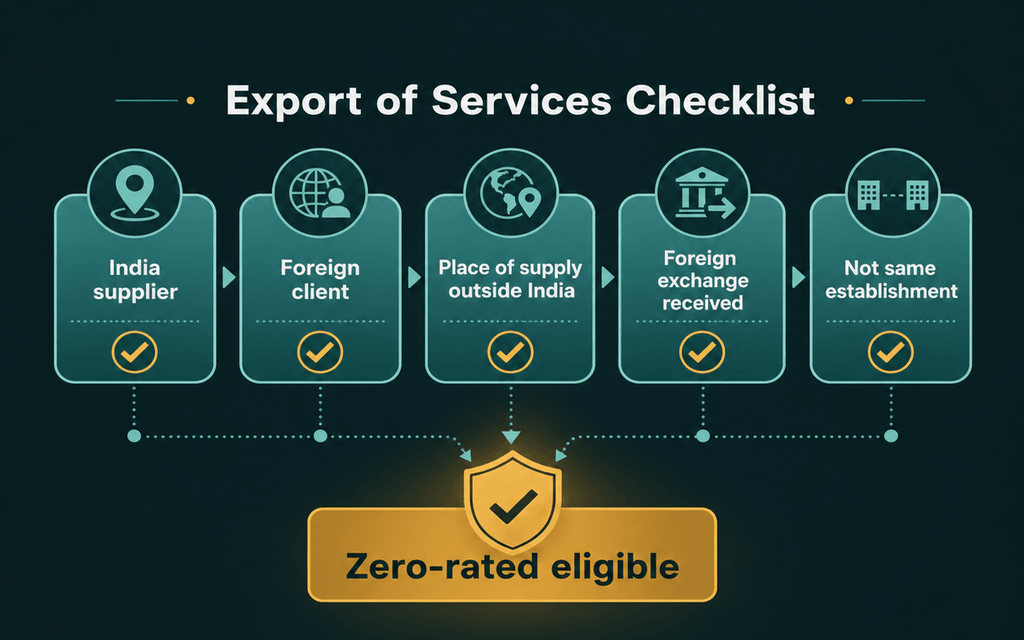
Infographic checklist for AI freelancer export of services under GST, covering Indian supplier, foreign client, place of supply outside India, foreign exchange receipt, and distinct establishment test.

Export status depends on legal conditions, not marketing labels. Whether your work is prompt engineering, AI automation consulting, or content operations, the same criteria logic applies.

A practical checklist in 2026 should validate all five export conditions before finalizing tax treatment.

Export Checklist ItemWhat to ValidateWhy It Matters
Supplier locationYou are located in IndiaGST framework anchor condition
Recipient locationClient is outside IndiaCross-border test
Place of supplyOutside India as per rulesCore export qualification
Payment receiptConvertible foreign exchangeSupports zero-rated claim
Distinct person testNot same legal establishmentAvoids related-party rejection

Place of supply frequently drives the final decision. Client location and contractual setup usually matter more than your own seat location. Banking evidence of foreign inward remittance is the operational proof layer that protects your filing position.

3

GST Calculation Logic for Global AI Work

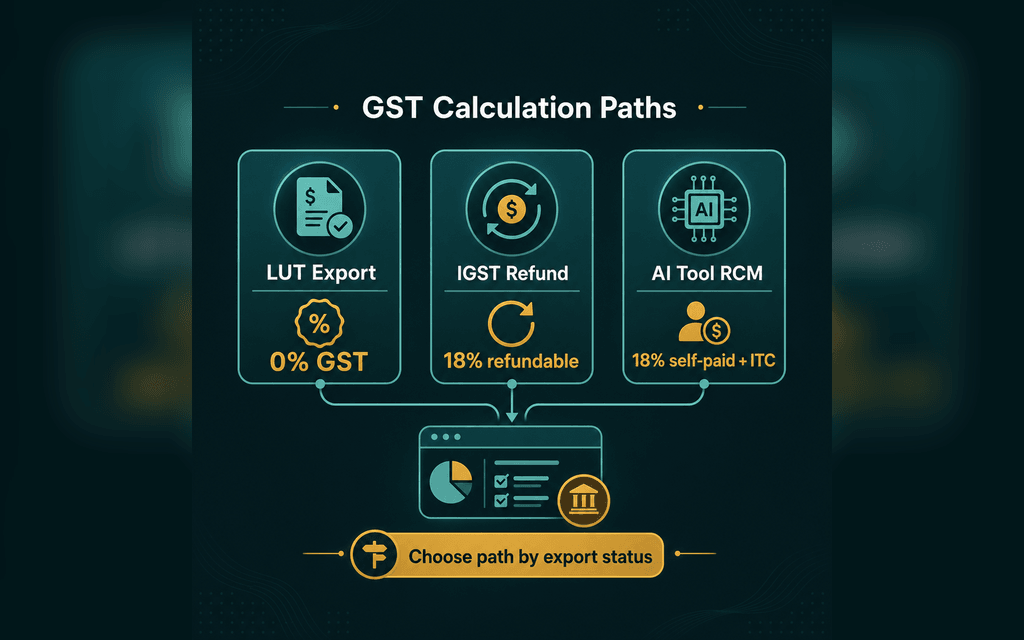
Three-path GST calculation infographic for global AI freelancers showing LUT export at 0 percent GST, IGST refund at 18 percent refundable, and AI tool RCM at 18 percent self-paid plus ITC.

A robust calculator should branch into three scenarios: export with LUT, export with IGST refund, and RCM on imported AI tools. This avoids one-size-fits-all tax math.

Scenario A: Export with LUT (0% Strategy)

When LUT is valid and export conditions are satisfied:

Total Invoice Value = Base Price + 0% GST

Scenario B: Export with IGST Refund

When invoicing with IGST and claiming refund later:

Total Invoice Value = Base Price + 18% IGST (Refundable)

Scenario C: RCM on AI Tool Subscriptions

For many imported digital services used in business:

RCM GST Payable = AI Subscription Base x 18%

Then claim eligible ITC in return workflow.

ScenarioInvoice OutputCash Flow EffectCompliance Focus
LUT export0% GST on invoiceBest short-term cash retentionLUT validity and remittance proof
IGST then refund18% IGST billedTemporary cash lockRefund workflow accuracy
RCM on AI toolsSelf-paid 18%Outflow then ITC recoveryExpense mapping and ITC claim

For planning rates and profitability simultaneously, combine Freelancer Rate Calculator with Tax Calculator.

4

FIRC and FX: The Documentation Layer That Protects You

In cross-border freelancing, tax treatment is only as strong as documentation quality. FIRC and bank advice records must clearly map payment receipt to export invoices.

Currency conversion also affects filing values and reconciliation quality. If invoice currency and settlement currency differ, your compliance workflow should preserve both with date-linked rates.

DocumentPrimary UseAudit Value
Invoice and contractService scope and recipient detailsSupports export nature
Bank remittance proof (FIRC equivalent records)Foreign receipt evidenceCritical for zero-rated claims
FX conversion logINR reporting consistencyReduces mismatch disputes
Expense tax recordsRCM and ITC supportDefends credit claims

Use Currency Converter to standardize invoiced and received value comparison before preparing monthly summaries.

5

Role-Specific GST Guides (pSEO Cluster Base)

Role-specific tax pages attract high-intent traffic because users search by workflow, not by statute title. This cluster can be expanded using AI freelancer sub-specialties.

Core page patterns:

  • GST for AI Prompt Engineers: marketplace micropayments and fee deductions
  • GST for Fractional AI Officers: long-term global retainers and milestone billing
  • GST for AI Content Creators: ad revenue and platform settlement trails
  • GST for SaaS Developers: app-store proceeds, global subscribers, and service classification
Role VariantPrimary Tax Pain PointBest Calculator Companion
Prompt engineerSmall global payouts and proof mappingIndia GST Calculator
Fractional AI officerRetainer structuring and export docsFreelancer Rate Calculator
AI content creatorPlatform payout reconciliationCurrency Converter
SaaS developerMixed domestic and global streamsSaaS Runway Calculator

This template design also helps build entity authority around AI work, global freelancing, and export tax compliance.

6

Using the Calculory Export and AI GST Tool

A 2026 GST workflow should behave like an operating system, not a static sheet. The tool should switch logic based on export status, remittance timing, and AI expense profile.

Suggested feature logic:

  1. 1.Export toggle: auto-apply zero-rated branch when export conditions are selected.
  2. 2.Currency layer: convert invoice and receipt values into filing-ready INR views.
  3. 3.ITC tracker: capture AI tool costs and estimate recoverable credits.
FeatureUser InputOutput
Export toggleClient location and LUT status0% or IGST path selection
FX conversionInvoice currency and receipt dateINR-equivalent filing value
ITC trackerAI tool subscriptions and taxesEstimated credit pool

For commercial planning alongside tax workflow, use SaaS Runway Calculator to see how tax cash timing affects business runway.

7

Compliance Checklist: Avoid a 2026 Tax Audit Shock

Strong compliance is mostly process discipline. The most common failures are timing errors, missing proof trails, and inconsistent return mapping.

Use this operational checklist each month:

  1. 1.Confirm export invoices are reflected correctly in GSTR-1 and GSTR-3B zero-rated sections.
  2. 2.Track the 180-day receipt timeline for each export invoice.
  3. 3.Match each inward remittance record to invoice IDs.
  4. 4.Reconcile RCM outflow and ITC claim entries for AI tools.
  5. 5.Maintain updated invoice and signature requirements for your billing threshold.
Compliance RiskTypical CausePrevention Control
Zero-rated rejectionMissing remittance proofInvoice-to-bank mapping log
Refund delayMismatch in reported valuesFX reconciliation before filing
ITC mismatchUntracked RCM expensesMonthly AI tool expense register

A simple monthly close workflow is usually enough to prevent most audit friction.

8

Conclusion: Scale Your Global AI Agency Safely

GST should not become a growth bottleneck for global AI freelancers. With export-first logic, evidence-first documentation, and disciplined return mapping, you can reduce avoidable tax leakage while staying compliant.

In 2026, your AI agent can do the work, but your finance stack must protect the profit. Build that stack early and your global expansion becomes much easier to sustain.

CTA: Try our GST export calculator workflow, built for digital-first freelancers working across borders.

Frequently Asked Questions

Do AI freelancers need to charge GST on foreign clients in 2026?

If your service qualifies as export of services and documentation is in order, it can be treated as zero-rated under GST. In practice, many freelancers use LUT to invoice at 0% GST.

What is the difference between LUT and IGST refund route?

LUT usually avoids upfront GST outflow on export invoices. The IGST route involves charging and paying IGST first, then claiming refund later, which can affect cash flow.

Is FIRC mandatory for claiming export benefits?

Banking proof of foreign inward remittance is critical for supporting export treatment. You should maintain a clear trail linking each remittance to invoice references.

How is GST handled on OpenAI or other AI subscriptions?

Imported digital services may trigger RCM. A common model is paying 18% GST under reverse charge and then claiming eligible ITC in returns, subject to proper compliance.

What is the 180-day rule for export invoices?

Export payment should generally be realized within 180 days to preserve key tax treatment conditions. Delays can create compliance complications and require corrective action.

Can I file correctly if my invoices are in USD or EUR?

Yes. You should convert and report values consistently in INR for GST filing while preserving original currency records and receipt-date conversion evidence.

Author Spotlight

The Calculory Team

Tax Systems and Freelance Finance

We simplify tax logic for modern digital businesses with practical calculators, scenario models, and compliance-first workflows.

Verified Expert Educator
gst for ai freelancersforeign inward remittance gstexport of services gstlut vs igst refundrcm on ai toolsitc for freelancersusd to inr gst filingai agency tax compliancedigital nomad tax indiafreelance tax2026