Maths5 min readUpdated Apr 25, 2026

Guide to Interactive Math Games for Kids and Classrooms 2026

The Calculory Team

Education Content and Learning Design

Interactive math games in 2026 blend adaptive online platforms with low-prep classroom activities. Use this guide to pick the best game format by age, goal, and time.

Guide to Interactive Math Games for Kids and Classrooms 2026

Key Takeaways

  • Five-minute daily warm-ups with games like Nerdle can raise participation quickly because every student gets an immediate, low-pressure win.
  • Adaptive online platforms such as Prodigy and Legends of Learning can auto-adjust question difficulty in under 10 questions, reducing frustration for mixed-skill groups.
  • A balanced weekly plan works best: 2 to 3 digital sessions (15 to 20 minutes) plus 2 screen-free sessions (10 to 15 minutes).
  • Low-prep physical games like Math Twister and Human Number Line can be set up in under 5 minutes and improve classroom energy during transitions.
  • Grade-banded game design matters: K to Grade 2 activities should prioritize counting and shapes, while Grades 6 to 12 should focus on algebra, coordinates, and data reasoning.
  • Teachers who align Friday game blocks with Monday lesson objectives report better retention than using random game time without curricular links.

Quick Comparison

1

The Evolution of Math Engagement in 2026

Math engagement has moved far beyond worksheets. In 2026, the strongest programs combine quick digital feedback with movement-based classroom tasks. This shift matters because math anxiety often comes from delayed feedback and fear of being wrong in public.

If you want students to practice more consistently, start with interactive loops where they answer, see feedback, and try again in seconds. Digital hubs on Calculory Math Games and targeted tools like the Percentage Calculator let you turn abstract ideas into immediate checks.

Classroom GoalTraditional MethodInteractive Upgrade (2026)Time Cost
Fluency drillSilent worksheet2-round timed game challenge5 to 10 min
Error correctionTeacher-led whole-class reviewInstant feedback game round5 min
Concept introLecture firstGame scenario then explain10 to 15 min
Exit ticketPaper quizQuick digital puzzle check3 to 5 min

Use the Arithmetic Sprint game as a daily entry routine, then verify tricky answers with the Average Calculator when reviewing class performance.
2

Best Interactive Online Math Games (Digital Platforms)

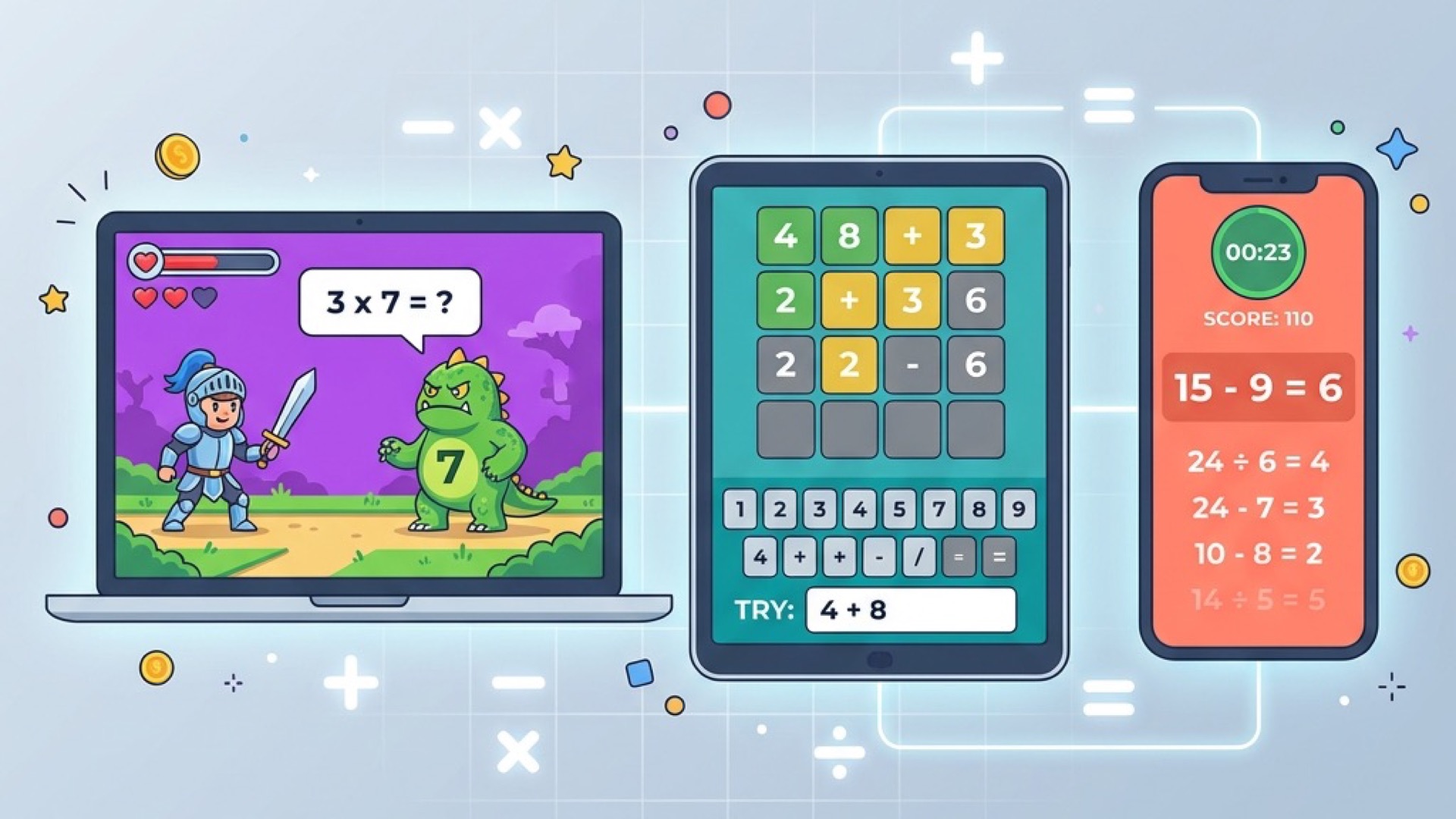
Three digital math game platforms showing an RPG quest with a knight battling a math monster on laptop, a Nerdle-style number puzzle on tablet, and a timed arithmetic speed drill on smartphone

Online math games are the center of most 2026 implementations because they scale across home and classroom contexts. The best platforms now blend curriculum mapping, adaptive difficulty, and short-session play so teachers can fit them into real timetables.

Cool Math Games and MathGames.com remain strong free hubs for logic and arithmetic puzzles. Legends of Learning is a top teacher choice for curriculum-aligned quests. Prodigy stays dominant for RPG-style progression in Grades 1 to 8. Nerdle remains one of the best five-minute warm-ups for middle years and above.

PlatformBest ForGradesSession LengthClassroom Use Case
Cool Math GamesLogic and puzzle stamina3 to 1010 to 15 minEarly finisher rotation
MathGames.comSkill-targeted drillsK to 88 to 15 minTopic reinforcement
Legends of LearningStandards alignment3 to 815 to 25 minTeacher-assigned quest
Prodigy MathAdaptive RPG motivation1 to 815 to 20 minHomework and station work
NerdleMental math warm-up5 to 123 to 5 minMorning starter

When choosing between platforms, focus on the goal for that block: fluency, concept exposure, or review. For a broader app-by-app breakdown, pair this guide with our Best Math Training Apps in 2026.

3

Fun Classroom Math Games (Low Prep, High Movement)

Not every strong math game needs a device. Low-prep physical games work especially well when attention drops, after lunch, or before dismissal. They also reduce passive screen time while preserving competitive energy.

Math Twister, Trashketball, and Human Number Line can be launched in minutes with whiteboard prompts and tape markers. Competitive review formats such as Bingo, Jeopardy, and Around the World remain effective when question sets match current unit targets.

GamePrep TimeCore SkillBest Group Size
Math Twister5 minMental computation4 to 12
Trashketball3 minProblem-solving speed10 to 30
Human Number Line5 minInequalities and decimals8 to 25
Math Bingo10 minFact fluency and review10 to 35
Around the World2 minRecall accuracy8 to 30

For rapid point tracking during team games, use the Fraction Calculator and Proportion Calculator to settle disputes quickly and keep momentum.

4

Creative Math Activities by Grade Level

Grade-level matching is what turns a fun activity into real learning. Younger learners need concrete visuals and touch-based counting. Older learners engage more when strategy and open-ended challenge are built in.

Grade BandBest ActivitiesPrimary SkillsIdeal Time Block
K to Grade 2Shape Scavenger Hunt, Counting CaterpillarsShape ID, sequencing, one-to-one counting10 to 15 min
Grades 3 to 5Pizza Division, Multiplication BaseballFractions, times tables, estimation15 to 20 min
Grades 6 to 8Coordinate Battleship, Nerdle routinesCoordinates, order of operations, reasoning10 to 20 min
Grades 9 to 122026 Challenge, budgeting simulationAlgebraic fluency, constraints, financial literacy20 to 30 min

The 2026 digit challenge is especially strong for mixed-ability classes because students can solve one objective in many ways. Ask learners to build numbers 1 through 20 using only digits 2, 0, 2, and 6 with different operations.

If students need extra support with expression checks, the Algebra Graphing Calculator can validate equivalent forms after each round.

5

Offline and Screen-Free Math Games That Still Work

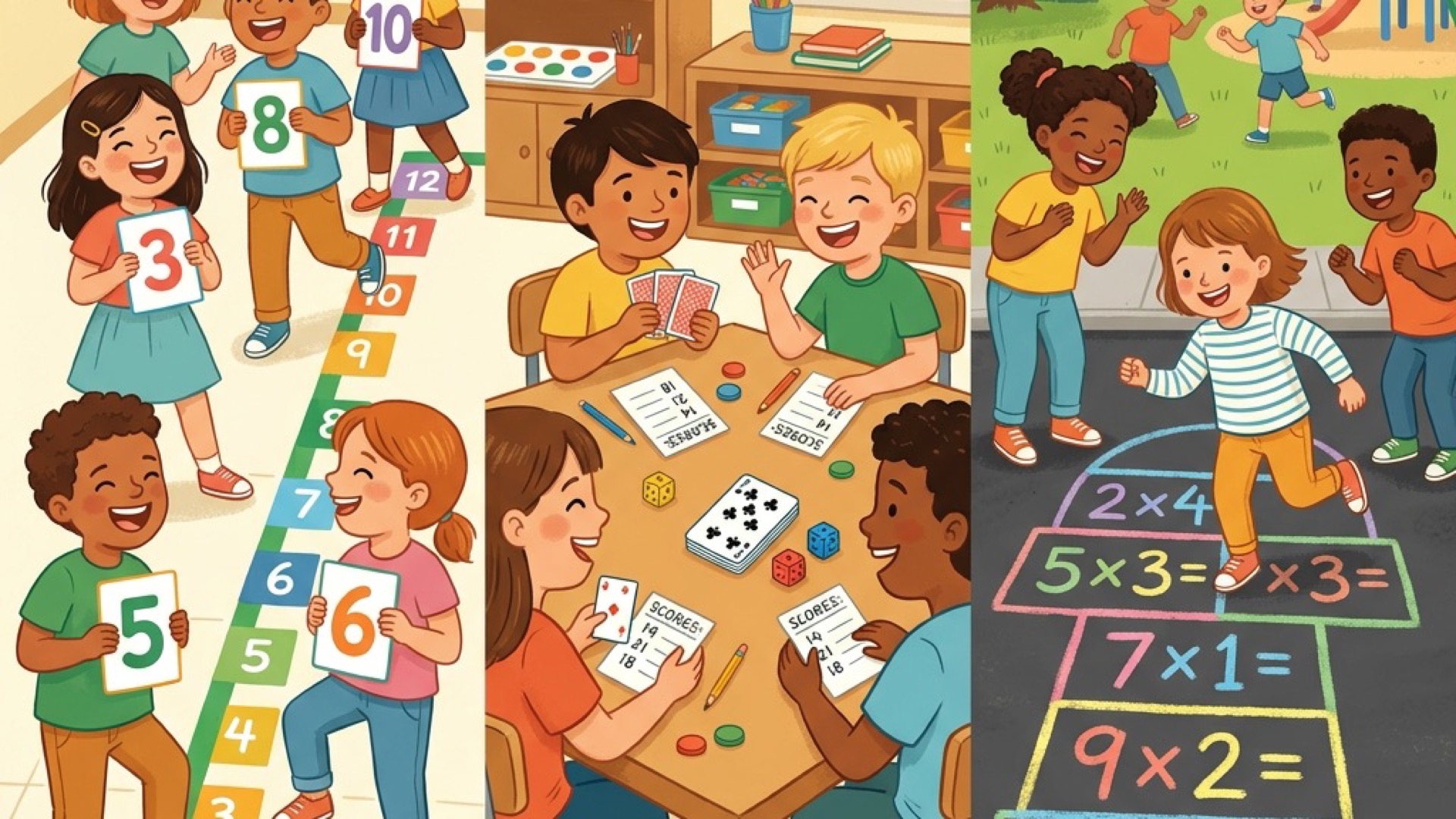
Three screen-free classroom math activities: children arranging themselves on a floor number line with cards, kids playing a card and dice math game at a table, and students doing chalk multiplication hopscotch on a playground

Screen-free math play still has a clear role in 2026. It helps with attention resets, social interaction, and tactile reasoning, especially in early grades and mixed-energy classrooms.

Card games like War, 24, and Pig Dice deliver high repetition without feeling repetitive. Chalk Math on playground surfaces adds movement. LEGO fraction builds make part-to-whole reasoning visible.

Screen-Free GameMaterialsSkill FocusAge Fit
War (cards)Standard card deckComparison and orderingK to 5
24 (cards)Number cardsOperations fluency3 to 12
Pig DiceTwo dice and score sheetProbability and risk4 to 12
Chalk hopscotch mathChalk and open floorMultiplication recall2 to 8
LEGO fractionsMixed brick sizesFraction modeling2 to 6

A practical rule is to alternate one digital session with one physical session when possible. This keeps novelty high and behavior smoother during transitions.

6

How to Choose the Right Activity Fast

Choice overload is real. A simple filter by skill level, environment, and available minutes helps you choose quickly before class starts.

Game TypeSkill LevelBest EnvironmentTime Required
Digital RPGGrade 1 to 8Home or individual station20+ mins
Active gamesAll agesClassroom or gym15 mins
Quick drillsGrade 3+Morning starter5 mins
Strategy puzzlesGrade 5 to 12Independent or pair work10 to 15 mins

Use this decision flow:

  1. 1.Pick the learning target first.
  2. 2.Match activity length to your real class window.
  3. 3.Choose one game students already know plus one new option.
  4. 4.End with a quick debrief question.

If your target is percentage fluency, run a 5-minute game round first, then apply the same numbers in the Percentage Calculator so students connect play with formal method.

7

Tips for Teachers and Parents: Make Games Stick

Games only improve outcomes when the structure is intentional. Three implementation choices matter most: scaffolding, collaboration format, and lesson alignment.

Scaffolding

Start with smaller number sets or fewer operations, then increase complexity once accuracy crosses about 80% for the group.

Collaborative vs Competitive

Use team talk when introducing new concepts. Use individual races when practicing known skills where speed matters.

Integration With Weekly Plans

Tie game day directly to your next assessment objective, not as disconnected reward time.

Implementation LeverLow-Risk StartScale-Up Move
DifficultySingle-step promptsTwo-step or mixed-operation prompts
FormatPairs and triadsTimed solo rounds
FeedbackWhole-class answer revealPeer explain and rebuttal
Assessment linkExit slip with 2 questionsMini quiz with 5 mapped items

For AI-supported homework help after class, share this companion review: Best AI Math Solver in 2026.

8

Conclusion: Make Math the Highlight of the Day

The strongest 2026 math routines mix adaptive online games with short movement-based activities. Start simple: one five-minute digital warm-up, one low-prep physical game, and one debrief question that links game strategy to formal math language.

When students see progress quickly, resistance drops and participation rises. That is why online platforms are so effective right now: they personalize challenge levels in real time while giving you usable classroom data.

If you want one practical launch plan this week, run Nerdle or a sprint-style game on Monday, Prodigy or Legends of Learning mid-week, and a screen-free team challenge on Friday. Keep the cycle for four weeks, then compare confidence, speed, and accuracy changes with your baseline.

Frequently Asked Questions

What is the best online math game for classroom use in 2026?

For most classrooms, Prodigy and Legends of Learning are top picks because they combine adaptive difficulty with teacher-friendly assignment control. If you only have 5 minutes, Nerdle is often the easiest high-impact warm-up.

How much screen time should math games use each week?

A practical target is 45 to 60 minutes total per week for core classes, usually split across three short sessions. Pair that with 20 to 30 minutes of movement-based or card-based math games to keep balance.

Do online math games actually improve test performance?

They can, when game content matches assessment objectives. Classes that use short, objective-aligned game practice two to three times per week usually see better fluency and fewer blank responses on timed sections.

What is a good budget for starting classroom math games?

You can start with $0 using free browser games and paper-based activities. If you allocate a small budget, even $30 to $60 can cover dice, card decks, reusable whiteboards, and printed game boards for a full class set.

Which math games work best for mixed ability groups?

Adaptive digital platforms are strongest for mixed ability because each learner receives a different question level automatically. In offline settings, station rotations with leveled prompt cards keep advanced students challenged while supporting learners who need simpler entry points.

How long should a classroom math game round last?

Most effective rounds run 8 to 15 minutes. Under 5 minutes can feel rushed for new concepts, while over 20 minutes often shifts focus from math objective to game mechanics.

Author Spotlight

The Calculory Team

Education Content and Learning Design

We test digital and classroom math tools to help teachers and families build stronger number sense with practical, low-friction routines.

Verified Expert Educator
interactive math gamesonline math games for kidsmath games for classroommath activities for teacherslow prep math gamesscreen free math gamesprodigy math alternativesnerdle classroom warm upmath engagement strategieseducation2026