Real Estate9 min readUpdated Mar 31, 2026

Renting vs Buying in 2026: The Complete Financial Breakdown

The Calculory Team

Real Estate and Mortgage Analysts

Is buying still the path to wealth in 2026? We break down the 5-year breakeven math, compare 6.5% mortgage costs against rental flexibility, and show you exactly when each option wins.

Renting vs Buying in 2026: The Complete Financial Breakdown

Key Takeaways

  • The 5 to 7 Year Breakeven: In the 2026 market, buying only beats renting financially if you stay in the home for at least 5 to 7 years, because upfront costs (closing, down payment) need time to be offset by equity gains.
  • 6.5% Is the New Normal: With 30-year fixed rates stabilizing between 6.0% and 6.5%, the monthly payment on a $400,000 home is now $780 more per month than it would have been at a 3% rate.
  • Renting Is Not Throwing Money Away: A renter who invests their would-be down payment at a 7% annual return builds $63,000 in portfolio value over 5 years, often outpacing home equity in flat markets.
  • Hidden ownership costs (taxes, insurance, maintenance) add 30% to 40% on top of the mortgage payment. Budget for the house, not just the loan.
  • Your decision should be driven by your timeline, local market appreciation, and career mobility, not by cultural pressure to buy.
  • Use the Mortgage Calculator to model your specific scenario and compare total cost of ownership against renting.

The 2026 Housing Market: A New Financial Reality

The housing market of 2026 has entered a rebalancing phase. The era of sub-3% mortgage rates and frenzied bidding wars is over. Instead, 30-year fixed rates have stabilized between 6.0% and 6.5%, inventory has recovered to near pre-pandemic levels in many regions, and both buyers and renters face a more complex financial equation than at any point in the last decade. For many people, the question 'Should I rent or buy?' is no longer about culture or status. It is about pure financial math. The answer depends on your timeline, your local market, your career trajectory, and your ability to absorb the full cost of ownership, not just the mortgage payment.

How 2026 Compares to Previous Markets

Market Factor2021 (Peak)2023 (Correction)2026 (Current)
30-Year Fixed Rate2.9% - 3.2%6.7% - 7.2%6.0% - 6.5%
Median Home Price$347,500$389,800$412,000
Monthly Payment ($400K, 10% down)$1,517$2,352$2,271
Median Rent (3-Bed)$1,850$2,100$2,250
Housing Inventory (months)1.63.14.2

The monthly mortgage payment on a $400,000 home at 6.25% is $754 more per month than the same home at 3.0%. Over 30 years, that rate difference adds over $271,000 in total interest paid. Use our Mortgage Calculator to see how today's rates affect your specific scenario.
The 5-Year Breakeven: When Does Buying Actually Win?

When you buy a home, you face massive upfront costs that a renter never pays: a down payment (3% to 20% of the purchase price), closing costs (2% to 5%), and ongoing non-equity expenses like property taxes, insurance, and maintenance. For buying to be financially superior to renting, the home's appreciation and the equity built through principal payments must eventually exceed all of these unrecoverable costs. In the 2026 market, this breakeven point typically falls between 5 and 7 years. If you plan to move before that window, renting is almost always the mathematically superior choice.

Breakeven Timeline by Down Payment and Appreciation

Scenario3% Appreciation4% Appreciation5% Appreciation
5% Down Payment7+ years6 years5 years
10% Down Payment6 years5 years4 years
20% Down Payment5 years4 years3 years

Why does a larger down payment shorten the breakeven? Two reasons: you eliminate Private Mortgage Insurance (PMI), which saves $100 to $250 per month, and you start with more equity from day one, reducing the gap that appreciation needs to close.

The Selling Cost Trap

Many first-time buyers forget that selling a home is not free. Real estate agent commissions (typically 5% to 6% of the sale price), transfer taxes, and repair concessions can easily consume $20,000 to $30,000 on a $450,000 home. If you buy and sell within 3 years, these transaction costs will almost certainly wipe out any equity gains.

Selling CostTypical RangeOn a $450,000 Sale
Agent Commissions (5-6%)$22,500 - $27,000$24,750
Closing Costs (seller)$3,000 - $6,000$4,500
Repair Concessions$2,000 - $8,000$4,000
Staging and Prep$1,000 - $3,000$2,000
Total Cost to Sell$35,250

That is roughly 7.8% of the sale price consumed by the act of selling. On a home that appreciated only 3% per year, three years of gains total about $42,000. After subtracting $35,250 in selling costs, you have just $6,750 to show for three years of ownership, taxes, maintenance, and risk.

The True Monthly Cost: Renting vs Buying Side by Side

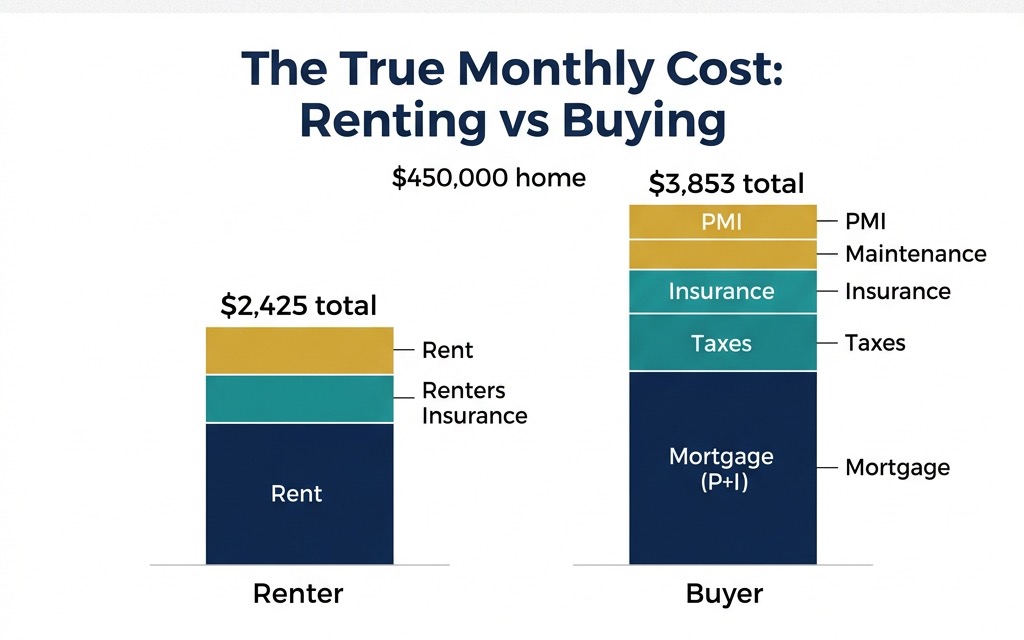
The most common mistake in the rent vs buy debate is comparing the rent check to the mortgage payment. That comparison is fundamentally incomplete. The mortgage is only one component of homeownership costs. Property taxes, insurance, maintenance, and PMI add 30% to 40% on top.

Monthly Cost Comparison: $450,000 Home vs $2,400 Rent

ExpenseRenterBuyer (10% Down)
Rent / Mortgage (P and I)$2,400$2,494
Property Taxes$0$469
Homeowners Insurance$0$192
PMI$0$135
Maintenance (1.5% rule)$0$563
Renters Insurance$25$0
Total Monthly Cost$2,425$3,853

The buyer pays $1,428 more per month than the renter. However, approximately $480 of the mortgage payment goes toward principal (equity), meaning the true unrecoverable cost gap is closer to $948 per month. Over a year, the renter saves $11,376 in cash flow, which could be invested.

> The hidden costs of ownership are substantial. For a deeper breakdown of property taxes, insurance surges, and maintenance math, read our companion guide: The Hidden Costs of 2026 Homeownership. Run your own numbers with the Mortgage Calculator to see exactly what your total monthly cost would be.

The Opportunity Cost of a Down Payment

One of the most overlooked factors in the rent vs buy decision is what happens to your down payment money if you do not buy. A renter who keeps their $45,000 in a diversified investment portfolio is not losing that money. They are deploying it differently.

$45,000 Down Payment: Buy vs Invest Over 5 Years

MetricBuy ($450K Home)Rent and Invest
Down Payment / Initial Investment$45,000$45,000
Home Equity After 5 Years (3% appreciation)$104,300N/A
Portfolio Value (7% annual return)N/A$63,115
Monthly Savings Invested ($948/mo)N/A$67,940
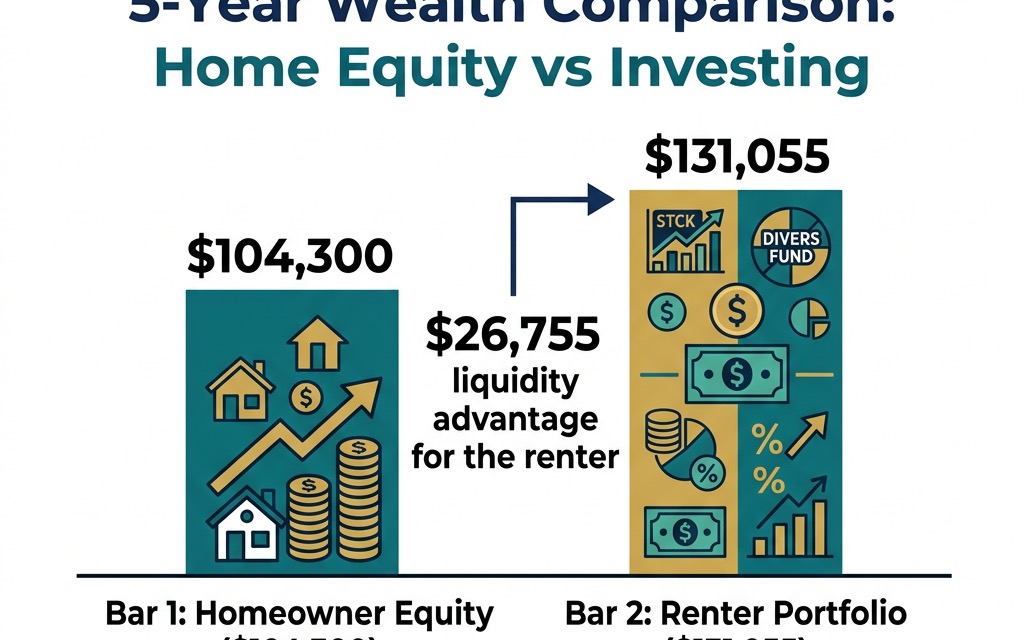
Total Wealth Built$104,300$131,055
LiquidityLow (must sell to access)High (sell anytime)

In this scenario, the renter who invests disciplinedly actually builds $26,755 more in total wealth over 5 years, and that wealth is fully liquid. The homeowner's equity is locked inside the property and can only be accessed by selling (with all its associated costs) or taking on additional debt through a home equity loan. The critical caveat: This comparison assumes the renter actually invests the savings. If the monthly cash flow difference goes to lifestyle inflation instead of a brokerage account, the renter's financial advantage disappears entirely. Buying a home is, in part, a forced savings mechanism. For people who struggle to invest consistently, that forced discipline has real value.

To see how your investment returns compare to local home appreciation, model both scenarios with the Mortgage Calculator for the ownership side and a compound interest calculation for the investment side.

The Flexibility Premium: When Renting Is the Smarter Move

Homeownership is often framed as the cornerstone of financial stability, but for many professionals in 2026, it can become a financial anchor. Renting provides a 'flexibility premium' that has a real, calculable dollar value.

When Renting Wins: Career Mobility Scenarios

ScenarioCost of Being Locked InVerdict
Job offer in another city (20% raise)$35,000 selling costs to relocateRent
Industry downturn, need to move for workForced sale in a down marketRent
Remote worker, may relocate for lifestyle$35,000+ transaction costs each moveRent
Stable career, staying 7+ years$0 (no move needed)Buy
Growing family, need more space in 2-3 years$35,000 selling + new closing costsRent

Consider this: a $20,000 raise in a new city is worth $100,000 over five years. If owning a home makes you hesitate to accept that offer because of the $35,000 cost to sell and relocate, the home has become a career liability. Renting also protects your liquid capital. Keeping a $50,000 down payment in a diversified portfolio means you can access it in days, not months. In an emergency, whether a medical crisis, a family need, or an unexpected career disruption, liquid savings are worth far more than illiquid home equity.

If you are in a high-growth phase of your career where job changes every 2 to 3 years are likely, the flexibility premium of renting can be worth $30,000 to $50,000 in avoided transaction costs alone. Use the Commuting Cost Calculator to factor in the commute savings of choosing a rental closer to your workplace.

Scenario Analysis: The $450,000 Decision Over 5 Years

Let us put everything together with a comprehensive 5-year comparison. This is the analysis most 'rent vs buy' articles skip: a full accounting of every dollar spent, invested, and earned.

Assumptions

  • Option A (Rent): $2,400 per month, increasing 3% annually. Renter invests down payment and monthly savings at 7% annual return. - Option B (Buy): $450,000 home, 10% down ($45,000), 6.25% rate, 1.25% property tax, $2,300 annual insurance, 1.5% maintenance.

5-Year Financial Comparison

CategoryRenterBuyer
Total Housing Payments$153,180$231,180
Closing Costs (buy + sell)$0$50,000
Down Payment Deployed$45,000 (invested)$45,000 (equity)
Equity Built (principal + appreciation at 3%)N/A$104,300
Investment Portfolio Value$131,055N/A
Net Position After Selling Costs$131,055$54,300
5-Year AdvantageRenter ahead by $76,755 (if selling at year 5)

But here is the twist. If the buyer stays for 10 years instead of 5, the math shifts dramatically. At 3% annual appreciation, the home is worth $604,700 by year 10. Principal paydown adds another $72,000 in equity. After selling costs, the buyer's net position exceeds the renter's because the fixed mortgage payment becomes cheaper relative to rising rents.

The Crossover Point

YearRenter Net WorthBuyer Net Worth (after selling costs)Who Wins?
Year 3$78,200-$8,400Renter
Year 5$131,055$54,300Renter
Year 7$192,500$148,600Renter
Year 10$283,700$289,200Buyer
Year 15$425,100$512,800Buyer

The breakeven in this scenario is around year 9 to 10. After that, the buyer pulls ahead because their fixed mortgage payment stays flat while the renter faces compounding rent increases. This is why your time horizon is the single most important variable in the rent vs buy decision.

Rent vs Buy by City: Where the Math Changes

The rent vs buy calculation is intensely local. In some cities, buying is clearly better even at today's rates. In others, renting is the superior financial choice by a wide margin.

2026 Rent vs Buy Comparison by Metro Area

Metro AreaMedian Home PriceMedian Rent (3-Bed)Price-to-Rent RatioVerdict
San Francisco, CA$1,150,000$3,80025.2Rent
New York, NY$680,000$3,20017.7Toss-Up
Austin, TX$425,000$2,10016.9Toss-Up
Dallas, TX$380,000$2,20014.4Buy
Columbus, OH$285,000$1,80013.2Buy
Indianapolis, IN$245,000$1,60012.8Buy
Miami, FL$520,000$2,90014.9Toss-Up

How to Read the Price-to-Rent Ratio

The Price-to-Rent Ratio divides the median home price by the annual rent. It is the simplest indicator of whether buying or renting is cheaper in a given market. - Below 15: Buying is generally favored. The cost of owning is competitive with renting. - 15 to 20: A toss-up. Your personal factors (timeline, down payment, career mobility) tip the balance. - Above 20: Renting is generally favored. Home prices are too high relative to rents for buying to make financial sense in the short to medium term.

In expensive coastal markets with ratios above 20, you would need to stay in the home for 10+ years just to break even. In affordable Midwest and Southern markets with ratios below 15, buying can beat renting in as few as 3 to 4 years. Use the Rental Yield and Cap Rate Calculator to analyze specific properties.

The Decision Framework: A Step-by-Step Checklist

Instead of following generic advice, use this decision framework to determine which option is right for your specific situation in 2026.

Step 1: Determine Your Time Horizon

How Long Will You Stay?RecommendationConfidence Level
Less than 3 yearsRentHigh
3 to 5 yearsDepends on marketMedium
5 to 7 yearsLean toward buyingMedium
7+ yearsBuy (if financially ready)High

Step 2: Check Your Financial Readiness

Before buying, make sure you can check every box: - You have 10% to 20% saved for a down payment (20% eliminates PMI) - You have an additional 3% to 5% for closing costs, separate from the down payment - You have 3 to 6 months of full housing costs (not just the mortgage) in an emergency fund - Your total housing cost (mortgage + taxes + insurance + maintenance) is below 30% of gross income - You have no high-interest debt that would be better paid off first

Step 3: Calculate Your Local Price-to-Rent Ratio

Divide the price of the home you are considering by 12 months of comparable rent. If the number is above 20, renting is almost certainly better. If it is below 15, buying has a strong case. Between 15 and 20, your timeline and personal factors decide.

Step 4: Run the Numbers

Do not trust gut feelings on this decision. Plug your actual numbers into these tools: 1. Mortgage Calculator: Find your true monthly payment at today's rates 2. Rental Yield and Cap Rate Calculator: Analyze rental yields in your target market 3. Emergency Fund Gap Calculator: Make sure you have adequate reserves before committing 4. Offset Mortgage Calculator: See how your savings can reduce interest if you do decide to buy

The bottom line: There is no universal answer to 'rent vs buy' in 2026. The right choice depends on your timeline, your market, your career trajectory, and your discipline as an investor. What matters is running the math with your actual numbers instead of following outdated rules about homeownership being the only path to wealth.

Author Spotlight

The Calculory Team

Real Estate and Mortgage Analysts

We help home seekers navigate the complex financial trade-offs of the modern housing market with data-driven tools and clear analysis.

Verified Expert Educator
rent vs buy 2026renting vs buying a homeshould I rent or buyhomeownership costsreal estate 2026mortgage rates 2026price to rent ratiofirst time home buyerrent vs buy calculatorhousing market 2026