Regional9 min readUpdated Apr 26, 2026

Seattle Sales Tax vs NYC, Chicago, LA, and SF: 2026 Guide

The Calculory Team

Tax Comparison Research

Seattle's sales tax is 10.25% in 2026, tied with Chicago and LA for the highest of any major US city. See how it stacks up against NYC, SF, Houston, and Portland.

Seattle Sales Tax vs NYC, Chicago, LA, and SF: 2026 Guide

Key Takeaways

  • Seattle's combined sales tax is approximately 10.25% in 2026 (6.5% Washington state plus King County, city, Sound Transit RTA, and other district taxes), unchanged from 2025.
  • Seattle ties with Chicago and Los Angeles at 10.25%, making it one of the three highest combined sales tax rates among major US cities.
  • Compared to NYC (8.875%) and San Francisco (8.625%), a $1,000 purchase in Seattle costs about $13.75 to $16.25 more in tax.
  • Washington has no state income tax, so Seattle leans heavily on sales tax for revenue. California, New York, and Illinois all add a state income tax on top of their sales tax.
  • Groceries are exempt from sales tax in Seattle (and statewide in Washington). Clothing is fully taxable, unlike NYC where items under $110 are tax-free.
  • Portland, Oregon (3 hours south of Seattle) charges 0% sales tax. A $1,500 laptop costs $1,653.75 in Seattle versus $1,500 flat in Portland, a $153.75 saving for cross-border shoppers.

Quick Comparison: Seattle vs Major US Cities at a Glance
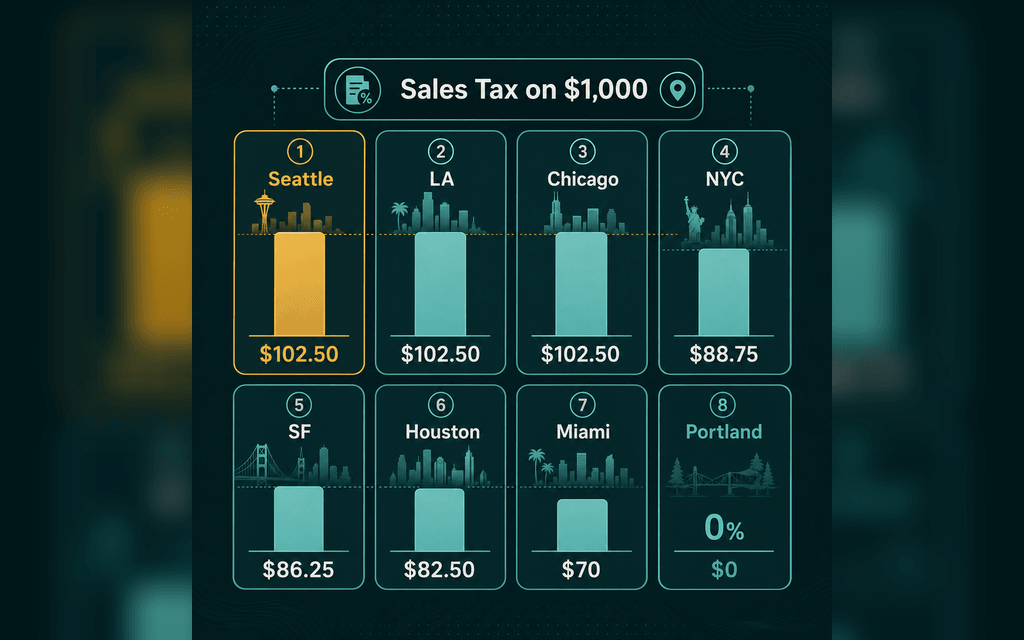
Infographic comparing sales tax on a $1,000 purchase across Seattle, Los Angeles, Chicago, New York City, San Francisco, Houston, Miami, and Portland.

Sales tax rates vary widely across major US cities, and the gap can change the real cost of large purchases by hundreds of dollars per year. Seattle sits at the top of the table, tied with Chicago and Los Angeles, while Portland (just over the Oregon border) sits at zero. Use the Seattle Sales Tax Calculator to see your exact tax on any purchase before reading on.

The table below shows the 2026 combined sales tax rate for the eight US cities most commonly compared to Seattle, along with a $1,000 worked example so the dollar gap is visible at a glance.

CityCombined RateState BaseTax on $1,000State Income Tax
Seattle, WA10.25%6.5%$102.50None
Los Angeles, CA10.25%7.25%$102.501% to 13.3%
Chicago, IL10.25%6.25%$102.504.95% flat
NYC, NY8.875%4%$88.754% to 10.9%
San Francisco, CA8.625%7.25%$86.251% to 13.3%
Houston, TX8.25%6.25%$82.50None
Miami, FL7%6%$70.00None
Portland, OR0%0%$0.004.75% to 9.9%

The headline rate is only half the story. Seattle, Houston, and Miami have no state income tax, so a low income tax burden offsets the sales tax. California and New York have both a high sales tax and a high state income tax. Portland flips the trade in the other direction: zero sales tax, but Oregon charges up to 9.9% state income tax.

Quick check: A Seattle resident buying a $30,000 car pays about $3,075 in sales tax. The same buyer in Portland pays $0 on the purchase itself, though Oregon residents face higher state income tax year-round.
How Does the Seattle Sales Tax Rate of 10.25% Break Down?

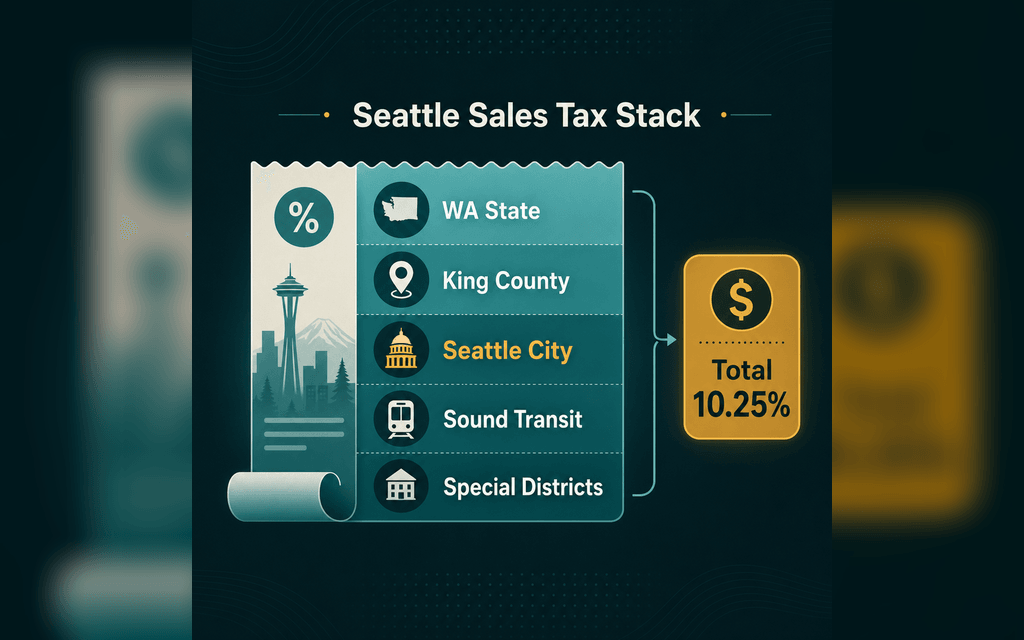
Infographic showing the Seattle sales tax stack made from Washington state, King County, Seattle city, Sound Transit, and special district layers adding up to a 10.25 percent total.

Seattle's 10.25% combined rate is not a single tax. It is a stack of five separate components administered by different jurisdictions. Understanding the breakdown explains why Seattle sits among the highest in the country and why the rate barely moves year to year.

ComponentRateWhat It Funds
Washington state base6.50%State general fund, schools, public services
King County local tax~0.65%County operations, criminal justice
City of Seattle local tax~1.20%Seattle general fund, parks, transit operations
Sound Transit RTA~1.40%Light rail, commuter rail, regional bus expansion
Other special districts~0.50%Mental health levy, housing, criminal justice levy
Combined total~10.25%All Seattle ZIP codes within King County

The largest single layer is the 6.5% state component, the same rate paid in every Washington city. The Sound Transit RTA portion (about 1.4%) is voter-approved funding for the regional light rail expansion that now connects Seattle, Bellevue, and Tacoma. Most King County cities (Bellevue, Redmond, Kirkland, Bothell) share the same combined rate as Seattle because they share the county and transit district taxes.

Seattle also has separate taxes that do not show up in the sales tax rate but do affect the cost of living: a 1.75 cent per ounce sweetened beverage tax, the JumpStart payroll tax on large employers, and a Business and Occupation (B and O) gross receipts tax. None of these affect everyday retail purchases, but they explain why Seattle's overall tax footprint is heavier than the sales tax alone suggests.

For a different city, swap in the Washington Sales Tax Calculator to compare Seattle, Tacoma, Spokane, and Vancouver WA side by side.

Seattle Sales Tax vs California: Los Angeles and San Francisco Compared

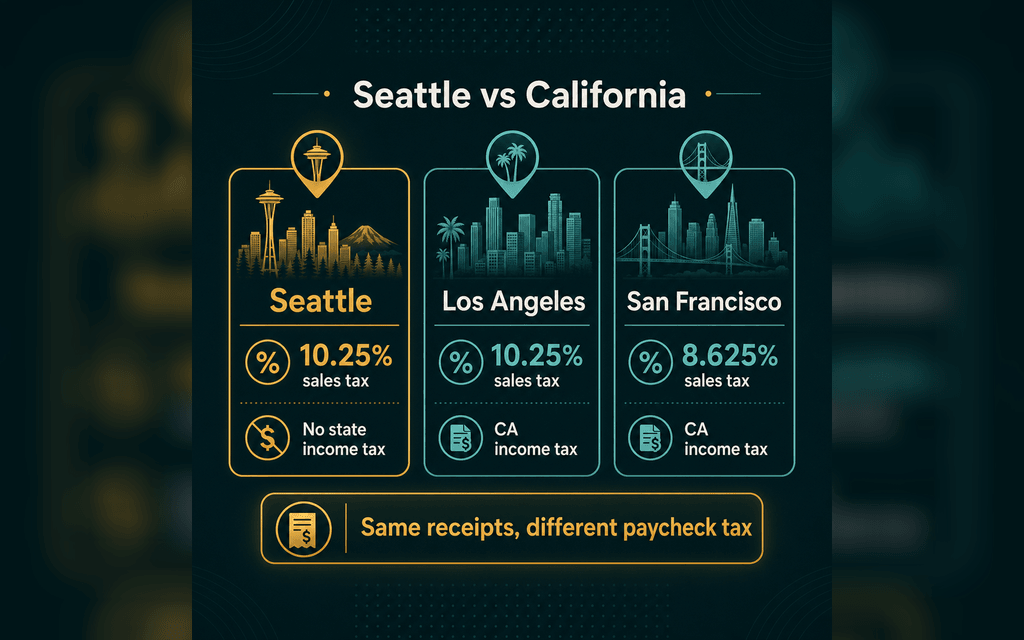
Infographic comparing Seattle, Los Angeles, and San Francisco sales tax rates with the state income tax trade-off between Washington and California.

California is the most common comparison because both states sit on the West Coast and both have major tech hubs that attract movers from Seattle. The two California cities most often compared are Los Angeles and San Francisco, which sit at very different points on the rate scale.

MetricSeattle, WALos Angeles, CASan Francisco, CA
Combined sales tax~10.25%~10.25%~8.625%
State base rate6.5%7.25%7.25%
GroceriesExemptExemptExempt
ClothingTaxableTaxableTaxable
State income taxNone1% to 13.3%1% to 13.3%
Tax on $500 purchase$51.25$51.25$43.13
Tax on $5,000 furniture$512.50$512.50$431.25

On pure sales tax, Seattle and Los Angeles are identical. A $5,000 furniture order costs the same in tax in both cities. San Francisco is meaningfully cheaper at 8.625%, saving about $81 on the same $5,000 purchase compared to Seattle.

The real difference is what happens when you stack income tax on top. A software engineer earning $180,000 in Seattle pays $0 in state income tax. The same engineer in Los Angeles or San Francisco pays around $14,000 to $15,000 per year in California state income tax (top marginal rate 9.3% at that income level, climbing to 13.3% above $1 million). That is several years' worth of sales tax savings absorbed by income tax in a single year.

The practical takeaway: California saves you a small amount on each receipt (especially in San Francisco) but takes far more out of your paycheck. Seattle does the opposite. Run the numbers with the Los Angeles Sales Tax Calculator and the San Francisco Sales Tax Calculator to see specific purchase costs.

Key insight: If you spend $40,000 a year on taxable goods, Seattle's higher rate over San Francisco costs you about $650 extra. Moving to California to save that $650 only makes sense if your income tax savings would exceed it, which they almost never do.

Seattle Sales Tax vs NYC: The Clothing Exemption Changes Everything

New York City's combined sales tax of 8.875% is roughly 1.4 percentage points lower than Seattle's. On most purchases, NYC is cheaper. But NYC has one rule that flips the comparison entirely for everyday spending: clothing and footwear under $110 per item are exempt from sales tax statewide.

Purchase TypeSeattle TaxNYC TaxDifference
$80 pair of jeans$8.20$0.00NYC saves $8.20
$300 winter jacket$30.75$26.63NYC saves $4.12
$1,200 laptop$123.00$106.50NYC saves $16.50
$25,000 used car$2,562.50$2,218.75NYC saves $343.75
$50 restaurant meal$5.13$4.44NYC saves $0.69

For a household that spends $4,000 a year on clothing items mostly under $110, NYC's exemption alone saves roughly $400 a year compared to Seattle, before factoring in the lower base rate on everything else.

The trade-off is income tax. New York State levies 4% to 10.9%, and NYC adds its own city income tax of 3.078% to 3.876% on top. A $150,000 earner in Manhattan pays roughly $13,500 in combined NY state and city income tax. The same earner in Seattle pays $0. Sales tax savings on a few jackets do not close that gap.

For the exact NYC calculation including the clothing exemption rule, use the New York City Sales Tax Calculator.

Seattle Sales Tax vs Chicago: The Closest Twin

Chicago is the city most structurally similar to Seattle on sales tax. Both sit at approximately 10.25% combined. Both stack a state base, county tax, city tax, and a regional transit authority tax. Yet a few subtle differences matter for a household budget.

MetricSeattle, WAChicago, IL
Combined rate~10.25%~10.25%
State base6.5%6.25%
Local stackKing County, Seattle, Sound Transit, leviesCook County, Chicago, RTA
GroceriesExemptReduced rate (~1% to 3%)
ClothingTaxableTaxable
Restaurant meals10.25% sales tax10.25% sales tax + extra restaurant tax
Soda or sweetened drinks1.75 cents per oz beverage taxCook County sweetened beverage tax history
State income taxNone4.95% flat

On a $1,000 weekly grocery run, Seattle pays $0 sales tax (groceries exempt) while Chicago pays roughly $10 to $30 in reduced grocery tax. That is the single biggest practical difference for everyday shopping. Over a year of $200 weekly groceries, the Seattle exemption saves a household around $500 to $1,500 versus Chicago.

Chicago also stacks add-on taxes that Seattle does not have at the same scale: a city restaurant tax of 0.5% on top of sales tax in the central business district, an amusement tax of 9% on concerts and streaming, and historically a soda tax. The headline 10.25% can climb above 11% on certain purchases.

For a side-by-side calculation, use the Chicago Sales Tax Calculator. The verdict for shoppers: same headline rate, but Seattle is meaningfully cheaper for groceries and restaurant tabs.

Seattle Sales Tax vs Houston, Miami, and Portland: The No-Income-Tax Peers

Three cities are most often compared to Seattle on the broader tax-burden question, not just sales tax: Houston (Texas), Miami (Florida), and Portland (Oregon). Texas and Florida share Washington's no-state-income-tax model. Oregon flips the model entirely.

CitySales TaxState Income TaxProperty Tax (avg)Tax Model
Seattle, WA10.25%None~0.93%High sales, no income
Houston, TX8.25%None~1.69%Mid sales, high property, no income
Miami, FL7%None~0.86%Low sales, no income
Portland, OR0%4.75% to 9.9%~0.97%No sales, high income

Miami is the lowest-tax peer of the four. Florida's 6% state base plus a 1% Miami-Dade county surtax is well below Seattle's 10.25%, and Florida has no state income tax. The trade-off in Florida is property insurance, which has surged in recent years and absorbs some of the savings.

Houston has no state income tax but charges among the highest property tax rates in the country (1.69% on average). On sales tax, Houston is roughly 2 percentage points below Seattle. The Texas total tax burden ends up similar to Washington's, just shifted from sales onto property.

Portland is the dramatic comparison. Oregon has no sales tax at all. A $1,500 laptop costs $1,653.75 in Seattle and $1,500.00 in Portland: a $153.75 saving on a single purchase. This is why border-shopping is genuinely common for big-ticket items, especially for shoppers in Vancouver, Washington who can drive 10 minutes south to avoid Seattle-area tax. Use the Houston Sales Tax Calculator and the Miami Sales Tax Calculator to model your own purchase costs.

Worth knowing: Oregon has consumer use tax requirements when goods purchased tax-free are brought back to Washington for use. In practice, enforcement on individuals is limited, but the law exists.

Why Is Seattle Sales Tax So High? The No-Income-Tax Trade-Off

Seattle's 10.25% rate is not arbitrary. It is the predictable result of a state constitutional position: Washington has never had a personal income tax, and voters have rejected one repeatedly (most recently in 2010). When you remove income tax as a revenue source, sales tax must do more of the work.

The consequence is a stacked structure where every level of government adds a sales tax component to fund services that would otherwise come from income tax:

  1. 1.State (6.5%): General fund, K-12 education, higher education, Medicaid match
  2. 2.County (~0.65%): King County criminal justice, public health, juvenile services
  3. 3.City (~1.2%): Seattle parks, libraries, fire and emergency services
  4. 4.Sound Transit RTA (~1.4%): Voter-approved light rail expansion (Sound Transit 3 measure passed 2016)
  5. 5.Special levies (~0.5%): Mental health, housing, criminal justice levies approved by voters

Each layer was approved by voters or legislators independently, often as a swap for not raising income tax. The cumulative effect is that Seattle sits at the top of the national rankings for sales tax even though no single component is unusually high by itself.

The practical effect on residents is that the system is regressive at the household level. A family earning $40,000 spends a higher share of income on taxable goods than a family earning $400,000, so sales tax bites harder lower down the income ladder. This trade-off (no income tax in exchange for high sales tax) is the central feature of Washington fiscal policy.

For a complete picture of how Seattle compares on income, sales, and property tax to other major cities, the US Tax vs Australia Tax guide walks through the equivalent international comparison.

Worked Examples: Seattle Sales Tax on Real Purchases

The simplest way to apply Seattle's 10.25% rate is the formula: Pre-tax price multiplied by 0.1025 equals the tax amount. Add the tax to the pre-tax price for the total. The examples below show what that looks like at common purchase sizes, with comparisons to NYC, SF, and Portland for context.

PurchasePre-taxSeattle TaxSeattle Totalvs NYCvs SFvs Portland
Coffee and pastry$12.00$1.23$13.23$13.07$13.04$12.00
Restaurant dinner$80.00$8.20$88.20$87.10$86.90$80.00
Winter jacket$300.00$30.75$330.75$326.63$325.88$300.00
Laptop$1,500.00$153.75$1,653.75$1,633.13$1,629.38$1,500.00
Furniture set$5,000.00$512.50$5,512.50$5,443.75$5,431.25$5,000.00
Used car$25,000.00$2,562.50$27,562.50$27,218.75$27,156.25$25,000.00
Engagement ring$8,000.00$820.00$8,820.00$8,710.00$8,690.00$8,000.00

Reverse calculation (extracting tax from a total): If you have a Seattle receipt showing $1,102.50 total, divide by 1.1025 to get the pre-tax price of $1,000, then subtract to find the tax of $102.50.

Groceries follow a different rule. A $200 weekly grocery run of unprepared food has $0 sales tax in Seattle because Washington exempts groceries statewide. The exemption does not extend to prepared food, hot deli items, restaurant meals, candy, or soda, all of which are taxable at the full 10.25% rate.

Seattle's sweetened beverage tax adds 1.75 cents per ounce on sugary drinks, separate from sales tax. A 12-pack of 12-ounce sodas adds $2.52 in beverage tax on top of the regular sales tax on the cost of the drinks.

For your specific purchase amount, the Seattle Sales Tax Calculator handles both forward and reverse calculations. The general Sales Tax Calculator lets you enter any city rate to model purchases anywhere in the US.

Frequently Asked Questions

What is the sales tax rate in Seattle in 2025 and 2026?

Seattle's combined sales tax rate is approximately 10.25% in both 2025 and 2026. The rate has not changed between the two years. It includes 6.5% Washington state, plus King County, city of Seattle, Sound Transit RTA, and other district taxes. Most King County cities including Bellevue, Redmond, and Kirkland share the same 10.25% rate.

Does Seattle have a sales tax?

Yes. Seattle charges approximately 10.25% combined sales tax on most retail purchases. Groceries (unprepared food) and prescription medicines are exempt. Clothing, electronics, prepared food, restaurant meals, and most services are taxable at the full rate.

Why is Seattle sales tax so high compared to other cities?

Washington has no state income tax, so jurisdictions rely heavily on sales tax to fund public services. Seattle stacks five components: 6.5% state, ~0.65% King County, ~1.2% city, ~1.4% Sound Transit RTA, and ~0.5% special levies for mental health, housing, and criminal justice. Each layer was voter-approved over decades, and the cumulative effect places Seattle among the top three highest combined sales tax rates of any major US city.

Is Seattle sales tax higher than NYC?

Yes. Seattle is approximately 10.25% versus NYC at 8.875%, a 1.375 percentage point gap. On a $1,000 purchase, Seattle costs $13.75 more in tax. However, NYC exempts clothing and footwear under $110 per item from sales tax, which Seattle does not. For everyday clothing shopping, NYC can be much cheaper.

How does Seattle sales tax compare to San Francisco?

Seattle's 10.25% is roughly 1.625 percentage points higher than San Francisco's 8.625%. On a $5,000 furniture purchase, that gap is about $81 more in tax in Seattle. The reverse comparison: California charges state income tax up to 13.3%, while Washington has no state income tax. A high-income earner saves far more on Washington income tax than they spend extra on sales tax.

How much sales tax do I pay on a $30,000 car in Seattle?

On a $30,000 vehicle in Seattle, the sales tax is approximately $3,075 ($30,000 multiplied by 10.25%), bringing the total to $33,075. This is in addition to vehicle registration fees and any motor vehicle excise tax. Some Sound Transit areas have additional vehicle-specific taxes that can add 0.3% on top.

Are groceries taxed in Seattle?

No. Unprepared food and groceries are exempt from sales tax in Seattle, in line with Washington state law. Prepared food (restaurant meals, hot deli items, food sold with utensils), candy, soft drinks, and dietary supplements are taxable at the full 10.25% rate. Seattle also charges a separate 1.75 cents per ounce sweetened beverage tax on sugary drinks.

Can I shop in Portland to avoid Seattle sales tax?

Yes, but with caveats. Oregon has 0% sales tax, so a $1,500 laptop costs $1,500 flat in Portland versus $1,653.75 in Seattle. Many Vancouver, WA residents drive across the border for big-ticket purchases. Washington has a use tax that technically requires residents to pay tax on items purchased out of state and brought back for use, though enforcement on individual consumers is limited in practice. Businesses face stricter use tax compliance.

Author Spotlight

The Calculory Team

Tax Comparison Research

We compare US state and city tax systems so shoppers, movers, and business owners can see the real cost of buying in one city versus another.

Verified Expert Educator
seattle sales taxseattle sales tax 2025seattle sales tax 2026seattle sales tax vs californiaseattle sales tax vs nycseattle sales tax vs chicagoseattle wa sales tax ratewhy is seattle sales tax so highdoes seattle have a sales taxsales tax seattle vs san francisco