How US and Australian Tax Systems Differ: A Quick Overview
The United States and Australia are both high-income, English-speaking countries with strong economies, yet their tax systems are structured quite differently. For professionals considering relocation, remote work arrangements, or cross-border financial planning, understanding these differences is essential.
Both countries use progressive federal income tax systems with multiple brackets. However, Australia's rates start higher at middle incomes, and the top rate of 45% applies at a far lower threshold than the US equivalent. Australia also adds a 2% Medicare levy on most income, creating an effective top rate of 47%.
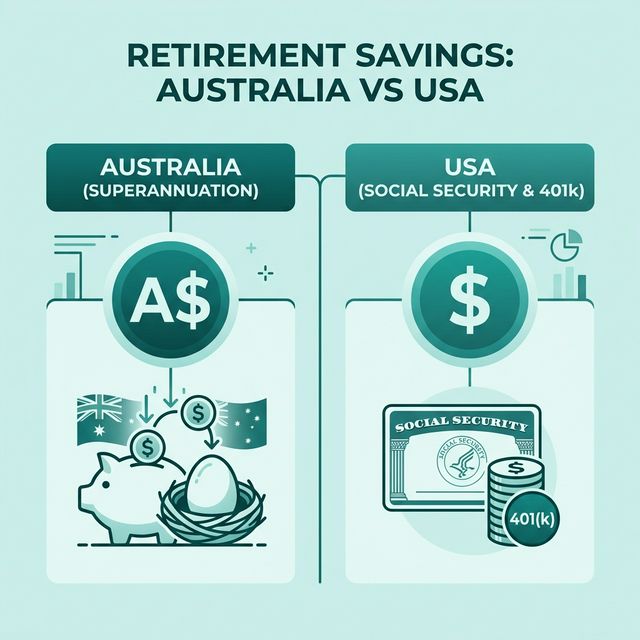
One of Australia's most distinctive features is superannuation, a compulsory employer-funded retirement contribution of 11.5% of gross salary paid on top of wages. There is no direct US equivalent. American workers rely on voluntary 401(k) contributions and Social Security funded through FICA payroll taxes.
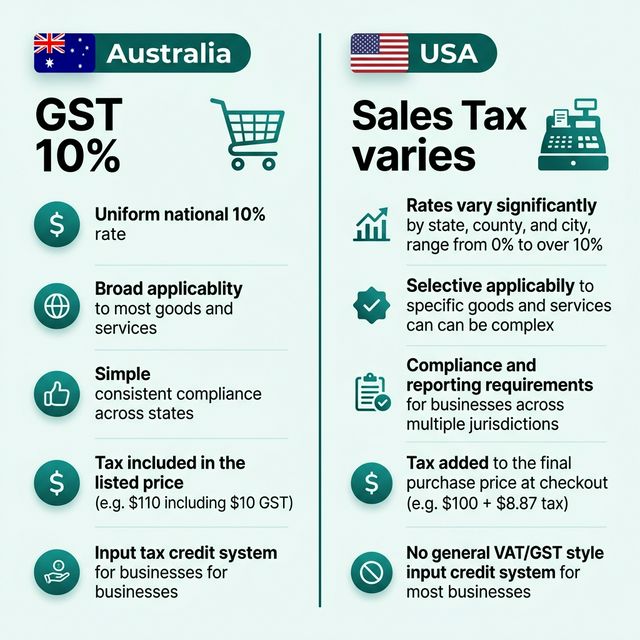
On consumption taxes, Australia applies a clean, uniform 10% Goods and Services Tax (GST) nationwide. The US has no federal sales tax and uses a patchwork of state and local rates ranging from 0% to over 11%.
Australia has no state income tax. Every Australian worker in every state or territory faces the same federal income tax rates. This differs sharply from the US where 41 states levy additional income taxes that can dramatically change your effective rate.
This guide compares every major layer of both systems with 2025 data to give you a complete, honest picture.